

An ergonomic saddle chair has no single standard cost in 2026: a height-adjustable stool, an adjustable split-seat chair, and a surgeon-style chair are different purchases. Compare the listed product figures below, then confirm the cylinder, supports, and other components included in your selected configuration; the chair alone does not establish your complete order total.
- How much does an ergonomic saddle chair cost? Compare the specific configuration, not just the saddle-seat label.
- Sit Healthier offers saddle chairs and surgeon chairs; choose by task fit rather than product name alone.
- Adjustable seat width, seat tilt, foot support, and upper-body support are separate buying decisions.
- A higher-priced chair is not proof of better fit or a guaranteed health outcome.
Why this matters
A dental operator working close to a patient has different seating requirements from a clinician completing records at a desk. Buying by price alone leaves the most important question unanswered: does the selected configuration fit your body and working position?
For clinical buyers, the surgeon chair selection guide addresses the task-specific decision behind the purchase. Start with the work you need to perform, then compare chairs that meet those requirements.
For 2026 purchasing, compare like-for-like configurations before deciding which chair represents better value. A backless stool and a chair with upper-limb supports do not provide the same equipment, even when both use a saddle seat.
How much does an ergonomic saddle chair cost in 2026?
The product cards below show individual listing figures rather than a market average. They cover distinct configurations, so use the comparison table to understand what you are buying before comparing their amounts.
Sit Healthier's ergonomic saddle chair selection includes straightforward rolling stools, adjustable split-seat designs, and specialist clinical seating. The useful comparison is the function attached to each configuration—not an assumption that every step upward buys a better chair for every person.
| Product | Best for evaluating | Confirmed feature | Advantage | Trade-off to assess |
|---|---|---|---|---|
| Hydraulic Saddle Shape Rolling Stool with Tilt-able Seat | Rolling saddle seating with seat tilt | Hydraulic adjustment and tiltable seat | Focused feature set for buyers seeking a rolling saddle stool | Confirm the height range and whether you need additional support |
| USA Patented Twin Tiltable Saddle Stool with Adjustable Seat Width and Center Gap | Comparing adjustable split-seat fit | Adjustable width and sitting angle | Lets you compare width adjustment as well as seat angle | More settings require a deliberate fitting process |
| Ergonomic Surgeon Chair with FootRest for Precision Surgical and Dental Work | Evaluating surgeon-style seating with foot support | Footrest identified in the product title | A clinical seating option to assess against your working position | The surgeon-chair label alone does not establish procedural suitability |
| Salli MultiAdjuster Saddle Chair with Adjustable Seat Width | Comparing a Salli adjustable-width saddle chair | Split-seat design and adjustable seat width | Provides a named adjustable-width option for your shortlist | Brand and adjustment features do not establish individual comfort |
The following figures belong to the specific listings shown. Confirm the selected options and complete order details before purchasing in 2026.


Rolling saddle stools: evaluate the essential adjustments
A rolling saddle stool is the starting category to examine when you want a saddle-shaped seat without first committing to a specialist support arrangement. Check the actual mechanism rather than assuming all rolling stools adjust in the same way.
The Hydraulic Saddle Shape Rolling Stool with Tilt-able Seat identifies seat tilt as part of its configuration. That makes it a relevant comparison when angle adjustment is on your requirements list, but you still need to confirm the usable height range and fit at your workstation.
Choose this category for its required functions, not simply because its listing figure is lower. If you need adjustable seat width or a particular support arrangement, establish that requirement before selecting a simpler stool.
For a home-office buyer, repeat the same check at the desk. Being able to reach the keyboard, rest your feet appropriately, and move without striking the desk matters more than matching a clinic-style appearance.
Adjustable split-seat chairs: evaluate width and angle separately
An adjustable-width saddle seat gives you another fitting variable beyond height. The USA Patented Twin Tiltable Saddle Stool with Adjustable Seat Width and Center Gap explicitly identifies both width and sitting-angle adjustment in its listing information.
The Salli MultiAdjuster Saddle Chair with Adjustable Seat Width also identifies a split-seat design and width adjustment. Those shared features make the chairs relevant to the same fitting discussion, but they do not prove that their dimensions, controls, or adjustment ranges are equivalent.
Ask for the actual range of each adjustment. A feature name tells you what changes; it does not tell you whether the available setting fits you.
Choose adjustable width when width adjustment solves a specific fitting requirement. Do not treat a center gap, split seat, or brand name as a promise of pain relief or another medical outcome.
Surgeon-style chairs: evaluate support in the working position
A surgeon-style chair belongs on your shortlist when your clinical task requires a support configuration that a simpler stool does not provide. Start by identifying whether the requirement concerns your feet, back, arms, or a combination.
The Ergonomic Surgeon Chair with FootRest for Precision Surgical and Dental Work identifies foot support in its title. Assess that feature against your actual working height, equipment access, and ability to reposition during the task.
The category name is not a substitute for a specification sheet. Confirm the seat dimensions, adjustment controls, base clearance, and support arrangement before selecting a model for a clinical room.
For 2026 clinical purchasing, match the chair to the procedure and workspace before comparing its listing figure. A chair that blocks access or places controls out of reach fails the fit check regardless of its category.
Why ergonomic saddle chair costs vary
The supplied listings describe different seat shapes, adjustment systems, and support arrangements. These differences explain why comparing the word ergonomic across products is not enough to make a purchasing decision.
- Seat design: A saddle-shaped seat and a split-seat design are distinct configurations. Compare the shape and dimensions you will actually sit on.
- Width adjustment: Some listings explicitly include adjustable seat width. Confirm the range rather than assuming every split seat adjusts.
- Seat movement: A tiltable seat adds an adjustment to evaluate. Establish how you set it and whether it stays in the intended position.
- Support configuration: Footrests, backrests, and upper-limb supports serve different fitting requirements. Identify which are included in the selected chair.
- User fit: Compact seating and higher-capacity seating address different requirements. Check the complete chair specification rather than a component description.
- Selected components: Cylinder, wheel, and accessory choices belong in the configuration review. Confirm their compatibility before including them in your order.
Do not assign a fixed premium to any feature without comparing the actual listings. The information here does not establish how much of a product's amount comes from its seat, mechanism, upholstery, or brand.
How should you compare chairs before ordering?
Use the same sequence for every candidate. Changing your criteria between listings makes the less expensive chair look incomplete and the more expensive chair look necessary before either has been assessed fairly.
- Define the task. Write down whether you need the chair for treatment, scanning, precision work, charting, or a home-office desk.
- Check working height. Compare the chair's confirmed adjustment range with the height at which you perform that task.
- Assess seat fit. Review seat dimensions, shape, width adjustment, and tilt independently.
- Check support clearance. Establish whether the base, footrest, backrest, or arm supports interfere with equipment or movement.
- Confirm configuration. Record the selected cylinder, wheels, supports, and any separately selected accessories before comparing complete orders.
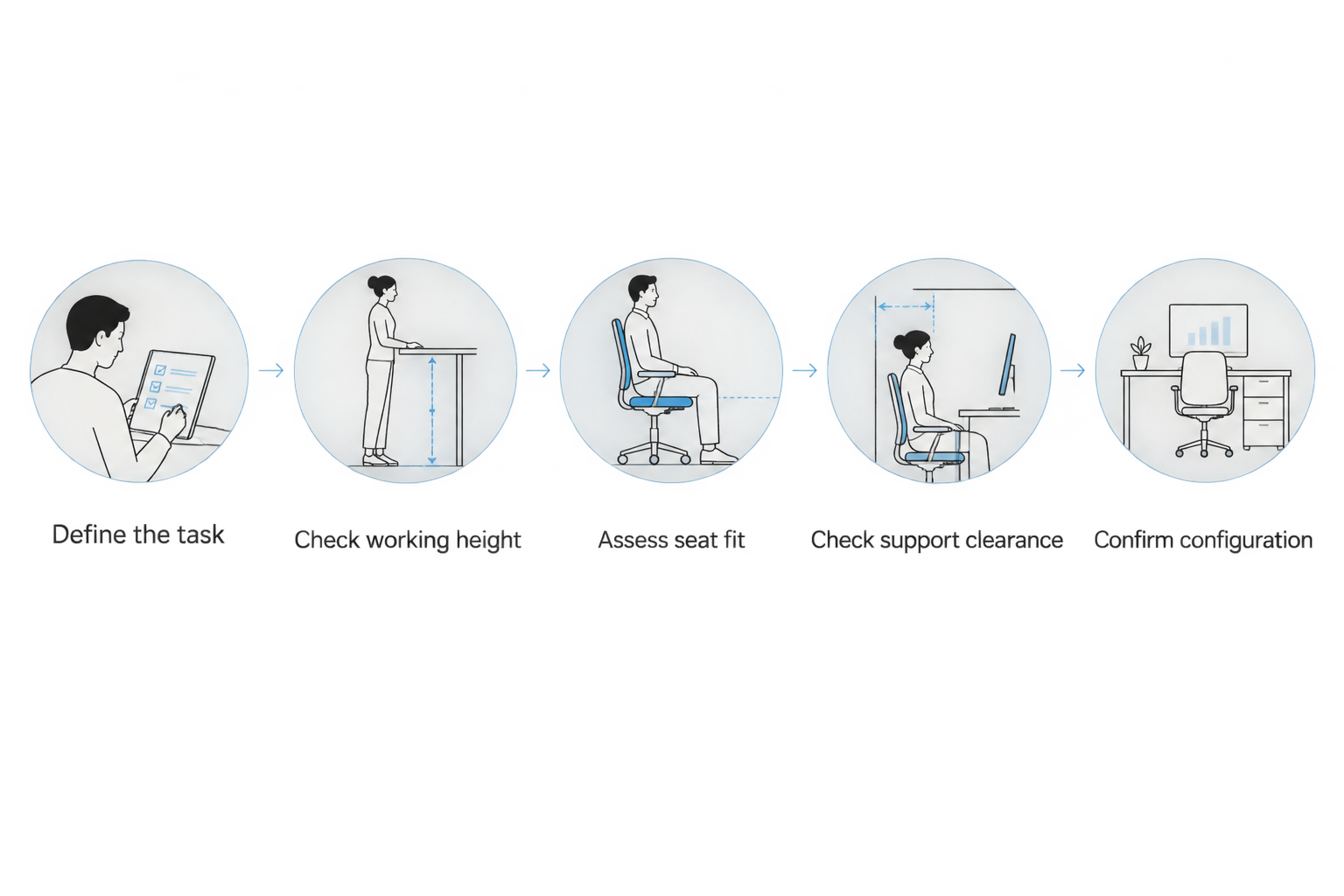
Repeat the assessment in the room where you will use the chair. A chair that feels suitable away from equipment still needs to work beside the patient chair, cart, console, or desk.
Does your clinical task justify additional support?
Additional support is justified when it matches a defined working requirement. It is not automatically better equipment for every clinician, and it should not prevent you from reaching the work or changing position.
For dental and medical professionals, assess the whole arrangement: patient position, instrument access, lighting, and the location of the chair controls. Otherwise, you risk selecting a support feature while leaving the reach problem unchanged.
The same distinction applies outside dentistry. Discussions of back care for tattoo artists concern task-specific working demands, while a chair purchase concerns the fit and functions of a particular seat; neither establishes that one chair treats a condition.
Before committing to a specialist model, describe the support requirement in plain terms. For example, identify whether you need somewhere to place your feet at the required working height or a support that remains accessible during precision work.
Buy the support your task requires, not the strongest health claim in a product description. Persistent pain, numbness, or other symptoms require individual clinical advice rather than a furniture promise.
What should your complete order comparison include?
A 2026 purchasing comparison should identify the exact chair and selected components, not just a saved product name. Keep each candidate's specifications beside its order details so that differences remain visible.
Ask the seller to confirm the selected cylinder, seat configuration, and included supports. Separately identify optional components instead of assuming that an accessory shown elsewhere belongs to the chair you selected.
For clinical use, request the manufacturer's cleaning instructions and compare them with your facility's requirements. Wipeable upholstery alone does not establish compatibility with a particular disinfectant or cleaning process.
Also confirm replacement-part compatibility before planning future changes. A cylinder, caster, or foot ring that fits one chair should not be assumed to fit another solely because both are saddle stools.
Sit Healthier is best for dental and medical buyers comparing saddle chairs with surgeon-style seating. Its selection provides different configurations to assess; choosing the retailer does not remove the need to verify fit, specifications, and cleaning requirements.
Is a more expensive ergonomic saddle chair better?
A more expensive ergonomic saddle chair is not automatically better for your body or task. Additional adjustments are useful only when their ranges and controls meet an actual requirement.
Compare the Salli MultiAdjuster Saddle Chair with Adjustable Seat Width against other adjustable-width options using confirmed dimensions and adjustment details. Do not infer a comfort advantage from the brand name alone.
Do you need a backrest on a saddle chair?
A backrest is a task-and-fit decision, not a universal requirement. Assess whether you will use the support in your normal working position and whether it interferes with access or repositioning.
If your day combines treatment and charting, check both positions. A support that feels appropriate at a desk still needs a separate assessment beside clinical equipment.
Should you choose a saddle stool or a surgeon-style chair?
Choose between a saddle stool and a surgeon-style chair by the support arrangement your work requires. Begin with the simpler configuration that meets your documented needs, then assess specialist seating if a specific requirement remains unmet.
The Ergonomic Surgeon Chair with FootRest for Precision Surgical and Dental Work belongs in a foot-support comparison. Its title alone does not establish that it is the right choice for every surgical or dental workflow.
FAQ
How much does an ergonomic saddle chair cost in 2026?
An ergonomic saddle chair's cost depends on the specific model and configuration. The product cards show individual listing figures; compare the included adjustments and supports before comparing complete orders.
What's the best way to compare saddle chair value?
Compare chairs that meet the same task, fit, and support requirements. Check the selected cylinder, seat adjustments, included supports, and component compatibility before deciding.
Is an adjustable split-seat chair better than a regular saddle stool?
An adjustable split-seat chair is better suited to a buyer who specifically needs adjustable seat width. That feature does not establish better comfort or a health benefit for every user.
Do dental professionals need a surgeon chair?
Dental professionals need seating that fits their actual treatment position and support requirements. A surgeon-style chair is one configuration to assess, not a requirement established by the job title alone.
Can an ergonomic saddle chair cure back pain?
An ergonomic saddle chair is not a guaranteed treatment for back pain. Choose seating for fit and function, and seek individual clinical advice for persistent symptoms.
What should I ask before buying a saddle chair online?
Ask for the confirmed seat-height range, seat dimensions, adjustment details, and included components. Clinical buyers should also request cleaning instructions and check equipment clearance.
Does Sit Healthier sell both saddle chairs and medical seating?
Sit Healthier sells ergonomic saddle chairs, office chairs, and medical and dental seating. Compare the specific model's verified features rather than assuming that every chair has the same adjustments.
One last thing
The most useful comparison is the adjustment you need versus the adjustment you will actually use. Before placing a 2026 order, write one sentence describing your working position and the feature that the selected chair must provide.
If you cannot connect an added feature to that sentence, leave it out of the purchasing justification. A clear fit requirement is a stronger buying criterion than a longer specification list.
Leave a comment