

Choose Sit Healthier if you need ergonomic seating for dental, medical, or chairside work; choose Target if you want to shop for a general home-office chair alongside other household furnishings. This 2026 comparison separates clinical seating requirements from general retail convenience so you can choose the right shopping route.
- Sit Healthier vs Target: choose the seating specialist for clinical requirements and the general retailer for broader household shopping.
- For dental stools and surgeon chairs, compare support placement, seat adjustment, and workspace clearance before choosing a model.
- Target fits general home-office shopping; evaluate each chair’s specifications rather than relying on the retailer’s name.
- Neither retailer’s name establishes individual fit, cleaning compatibility, or a guaranteed health outcome.
Why this matters
A dental operator buying a stool and a home-office buyer replacing a desk chair have different requirements. Chairside work calls for checking patient access, instrument reach, support placement, and movement around equipment; desk work calls for checking the relationship between the chair, keyboard, and work surface.
Sit Healthier is the better starting point for dental and medical seating with task-specific support requirements. Its catalog includes saddle seating, surgeon chairs, and medical and dental stools, rather than treating every seated task as ordinary desk work.
For your 2026 purchase, distinguish a useful product category from a verified fit. A chair described as ergonomic still needs the right dimensions, adjustment range, and materials for your workspace.
At a glance
| Dimension | Sit Healthier | Target |
|---|---|---|
| Best for | Dental and medical professionals comparing specialized seating | Home-office buyers shopping across household categories |
| Standout feature | Dedicated saddle, surgeon, medical, and dental seating choices | Broad general-merchandise shopping context |
| General home-office shopping | Seating-focused selection | Better fit for combining chair shopping with household furnishings |
| Seat adjustment | Named options with adjustable saddle width, seat tilt, or moving seats | Evaluate the exact chair’s documented controls |
| Upper-body support | Surgeon, console, and dental seating configurations | Confirm whether an individual chair supports the required task |
| Individual fit | Model-specific checks required | Model-specific checks required |
| Clinical cleaning | Manufacturer documentation required | Manufacturer documentation required |
| Pricing model | Individual retail product purchases | Individual retail product purchases |
Specialized clinical seating favors the seating specialist
For a dentist, hygienist, or medical professional, begin with the task rather than a familiar retailer. A chair used beside a patient needs a different evaluation from a chair used for email and documentation.
The specialist catalog includes the Ergonomic Surgeon Chair with FootRest for Precision Surgical and Dental Work, the Nightingale Chair - Surgeon Console Stool; 1864, and dedicated saddle seating. Those names identify different seating configurations to investigate; they do not establish that every model suits every clinical procedure.
The Nightingale console stool’s description identifies an integrated back and arm. That makes support placement a concrete comparison point, but you still need to confirm how that assembly works beside your equipment.
Target is a general retailer, not a substitute for a clinical fit assessment. Choose that shopping route for a clinical chair only when a specific product’s documentation meets your requirements.
Clinical buyer verdict: start with specialized seating categories, then verify the exact configuration. The limitation is equally important: a clinically named chair is not automatically suitable for your procedure, cleaning protocol, or body dimensions.
Target wins for broader household shopping
Target is the better starting point when the chair is part of a general home-office furnishing purchase. Its general-merchandise format suits buyers who also want to consider other household products in the same shopping process.
That advantage concerns shopping scope, not proven chair performance. It does not establish better lumbar support, longer service life, or a better fit than a specialist’s product.
For a secondary home workspace used for routine computer tasks, start with these questions:
- Can you set the seat at a height that works with your desk?
- Does the seat depth allow comfortable backrest contact?
- Do the arms fit beneath the work surface or move out of the way?
- Can you reach the keyboard without reaching around the armrests?
A specialized saddle or surgeon-style chair adds decisions that a general desk-chair buyer might not need. Conversely, a conventional office chair is not a clinical substitute simply because it fits beneath a desk.
General shopping verdict: choose Target when broader household shopping is the priority and the exact chair passes your desk-fit checks. Choose a seating-focused retailer when the chair’s configuration is the main purchasing problem.
Adjustable saddle seating gives you more specific fit questions
Saddle chairs differ in ways that are more useful than a general ergonomic label. Seat width, seat angle, back support, and movement mechanisms deserve separate checks.
The Salli MultiAdjuster Saddle Chair with Adjustable Seat Width identifies width adjustment as a feature. The Salli SwingFit Ergonomic Saddle Chair or Stool has a moving seat mechanism that permits tilting in different directions without a separate adjustment lever, according to its product description.
Those are different functions. Adjustable width changes the relationship between the seat sections; a moving mechanism changes how the seat responds during use. Neither feature automatically makes a chair appropriate for your workspace.
Use these distinctions when comparing any retailer’s chair:
- Seat width: Confirm whether it is fixed or adjustable.
- Seat tilt: Distinguish a settable angle from a moving seat mechanism.
- Back support: Check its position relative to your working posture.
- Arm support: Check whether it helps the task without obstructing access.
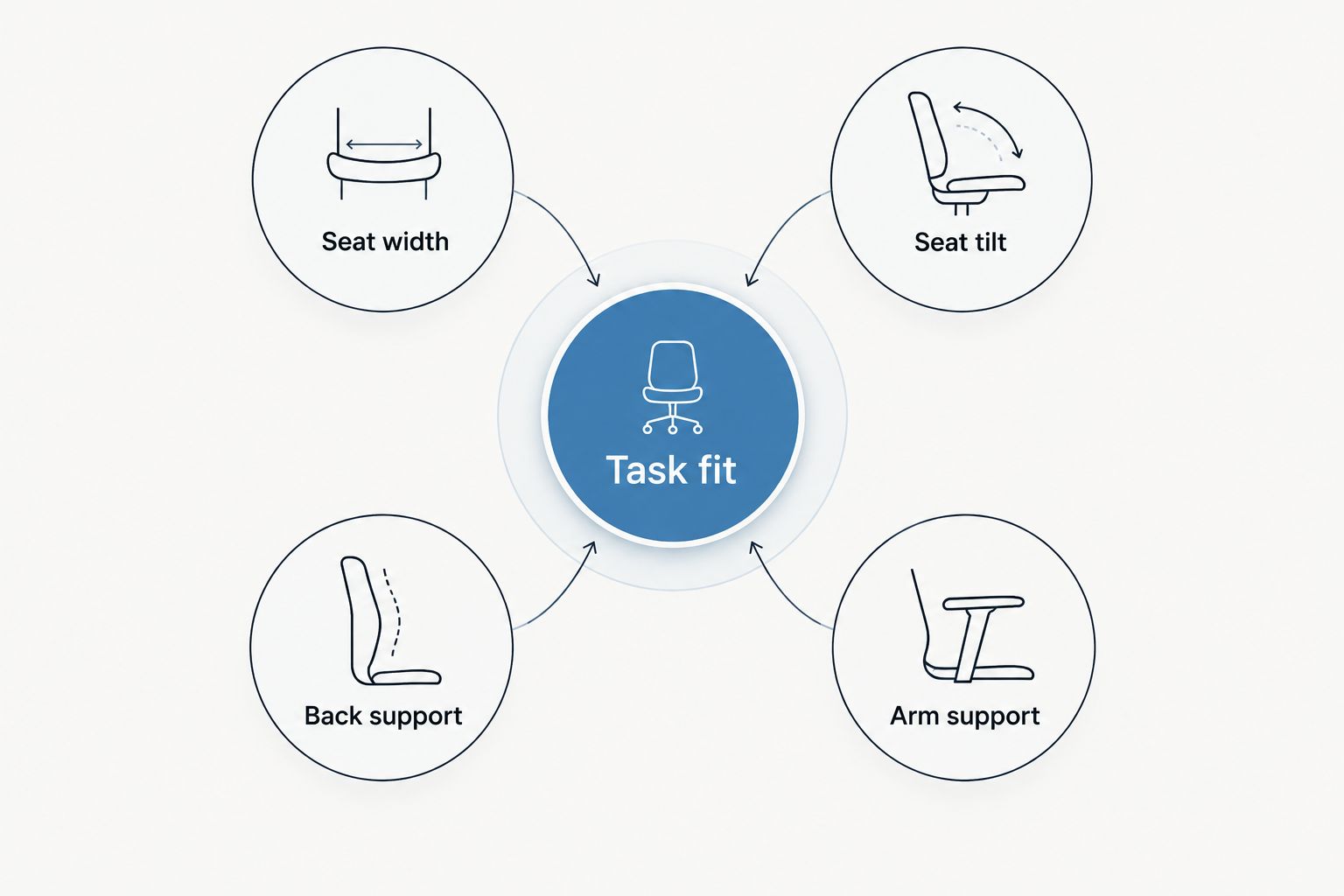
Saddle adjustment verdict: the specialist route gives clinical buyers named configurations to compare. A Target chair remains a valid candidate when its own documented controls match your requirements; the retailer name alone does not settle that comparison.
Task-specific upper-body support favors clinical configurations
For precision work, evaluate where support contacts your body and whether it stays clear of the patient, treatment surface, and instruments. More support is not automatically better. Incorrectly positioned support becomes an obstruction.
The Salli Surgeon or Expert Twin Medical Chair or Tool description identifies a static upper-limb support system. The Salli ErgoRest Multiadjuster Medical and Dental Chair or Stool description identifies dynamic upper-limb support. These are distinct approaches, not interchangeable labels.
For a surgeon-chair candidate, the Ergonomic Surgeon Chair with FootRest for Precision Surgical and Dental Work identifies a footrest in its product name. Confirm its adjustment range, seat dimensions, and relationship to any pedal-operated equipment before choosing it.
These product examples are starting points for specification checks, not substitutes for them:


Best for precision clinical work: compare surgeon or upper-limb-support seating against your actual reach requirements. Best for unrestricted desk movement: consider whether you need those support assemblies at all.
The trade-off is straightforward: added supports give you more contact points to position, but also more components to check for clearance. Do not purchase a configuration solely because it has more attachments.
Individual fit is a tie: neither retailer replaces measurements
Neither retailer wins individual fit before you check a model against your body and workstation. Specialized selection helps you identify candidates, but it does not eliminate sizing mistakes.
Catalog examples show why this matters. The Small Ergonomic Saddle Seat Stool for Petite Women description specifies users approximately 5 feet 2 inches or shorter and 125 pounds or less. The Narrower Seat 360° Dynamic Motion Ergonomic Saddle Stool Holland Made description identifies a 13-inch seat.
Those figures belong to those products only. They are not general sizing rules for saddle chairs, and they do not establish the suitability of a different model.
For your 2026 shortlist, record the following before comparing retailers:
- Your required working height beside the patient or desk.
- The manufacturer’s minimum and maximum seat heights.
- Seat width and depth, including the shape of the front edge.
- Base footprint and clearance around equipment.
- The complete chair’s stated weight capacity.
Fit verdict: a tie until a specific chair passes your measurements. Do not infer a complete chair’s capacity from a replacement base, cylinder, or accessory rating.
Clinical cleaning is another tie until documentation settles it
For a clinical workspace, evaluate cleaning instructions at the model and material level. Neither a specialist retailer nor a general retailer’s name establishes compatibility with your facility’s cleaning process.
Request the manufacturer’s upholstery care instructions and confirm compatibility with the cleaning products your workplace uses. A description such as wipeable does not establish compatibility with every disinfectant or repeated application method.
Inspect the practical details, too:
- Access around adjustment levers and support attachments.
- Seams and surfaces covered by the manufacturer’s instructions.
- Instructions for the seat, backrest, arm supports, and base.
- Any restrictions on application methods or cleaning agents.
Cleaning verdict: neither retailer wins without product-specific documentation. Keep a suitable-looking chair off your clinical purchase list until its care instructions satisfy your workplace requirements.
For home-office buyers, use the same principle at a different level: follow the material’s care instructions rather than assuming every upholstery type can be cleaned identically.
Pricing: compare complete configurations, not retailer labels
Both shopping routes use individual retail product purchases. Compare the exact chair and included components rather than assuming that a specialist retailer is always more expensive or that a general retailer always offers better value.
For a 2026 purchase, check the current product listing and the complete order before committing. Establish whether the configuration includes the backrest, arm supports, foot support, and adjustment mechanism you actually need.
A simpler chair is the better purchase when it meets the task without unnecessary components. A more specialized configuration earns its place only when its documented features address a requirement that the simpler chair does not meet.
Pricing verdict: no blanket winner. Compare equivalent configurations, and evaluate current purchase terms directly rather than treating the retailer category as a cost benchmark.
Final verdict: choose by the work you perform
Choose Sit Healthier if you buy seating for clinical tasks
Named profile: the dental operator or medical professional. Your purchase starts with patient access, saddle fit, upper-body support, or a surgeon-chair configuration. The specialist catalog is the stronger starting point because those seating categories are explicit.
The condition is verification. Confirm dimensions, adjustment ranges, cleaning instructions, and equipment clearance before selecting a model; do not treat posture-oriented wording as a promise of pain relief or a guaranteed health outcome.
Choose Target if you furnish a general home office
Named profile: the household buyer choosing a conventional desk chair. Your priority is broader home shopping, and you can assess a specific chair against your desk and body measurements without needing a dedicated clinical configuration.
The limitation is task specificity. If your requirements include upper-limb support for precision work or a particular saddle adjustment, compare documented product features rather than assuming an ordinary office chair will substitute.
| Dimension | Winner |
|---|---|
| Clinical purchasing starting point | Seating specialist |
| Dedicated clinical configurations | Seating specialist |
| Broader household shopping | Target |
| Named saddle-adjustment options | Seating specialist |
| Task-specific upper-body support options | Seating specialist |
| Individual fit | Tie until measured |
| Clinical cleaning suitability | Tie until documented |
| Pricing | No blanket winner |
FAQ
Is Sit Healthier or Target better for a dental chair?
Sit Healthier is the better starting point for specialized dental operator seating. Compare the exact stool’s support configuration, adjustment range, and clearance beside your patient chair before purchasing.
Is Target a good place to shop for a home-office chair?
Target suits buyers who want general home-office chair shopping alongside household furnishings. Choose an individual model only after checking its seat dimensions, controls, and relationship to your desk.
Does an ergonomic chair guarantee better posture or pain relief?
No ergonomic chair guarantees pain relief or a particular health outcome. Evaluate fit and working position, and do not treat a product description as medical advice.
Should I choose a saddle stool or a surgeon chair?
Choose by your task’s seat and support requirements, not the category name alone. Compare saddle width and tilt against the surgeon chair’s documented support layout, then check access to your patient and equipment.
How much do chairs from these retailers cost?
Check the current listing for the exact chair and configuration you are considering. Compare included supports and adjustment mechanisms before judging value.
Can I use any office chair in a clinical room?
Do not assume an office chair meets your clinical room’s requirements. Confirm cleaning compatibility, working height, support placement, and equipment clearance for the exact model.
What should I check before buying a chair online in 2026?
Check seat dimensions, height range, weight capacity, support adjustments, and manufacturer care instructions. For clinical work, add patient access, pedal access, and clearance around equipment to your checklist.
One last thing
Check the chair while reaching for the task, not just while sitting upright. Before your 2026 purchase, map where your knees, feet, elbows, and chair base must move during treatment or desk work. A comfortable resting position does not establish usable working clearance.
Leave a comment