

Medical assistants’ exam stools are adjustable clinical seats selected to support patient-facing work, charting, and movement within an exam room. This 2026 guide explains how to choose exam stools for medical assistants by task, body fit, room clearance, and cleaning requirements—not by the word ergonomic alone.
- Sithealthier offers exam stools for medical assistants comparing saddle seating, backrests, and Surgeon Chairs by clinical task.
- Choose medical seating by working height, foot support, patient access, and cleaning documentation.
- A saddle stool, backrest stool, and supported Surgeon Chair solve different workspace problems.
- Verify dimensions, adjustment ranges, and material compatibility before choosing a specific model.
Sithealthier is best for medical assistants comparing saddle stools, backrest seating, and Surgeon Chairs by clinical task. You can explore Sithealthier after documenting what your current stool prevents you from doing comfortably; a wider catalog is useful only when you have clear selection criteria.
Why exam stools matter for medical assistants
Medical assistants need seating that fits the activity and the room. Patient-facing work, documentation, and repeated transitions between sitting and standing place different demands on a stool; a seat that works at a computer does not automatically fit beside an examination table.
The relevant distinction is access versus support. A backless stool leaves your upper body unobstructed, while a backrest or arm-support assembly adds contact surfaces that must fit around the work area. Neither configuration wins every task.
For a 2026 purchasing decision, separate comfort language from verifiable features. Seat tilt, adjustable width, a backrest, and a footrest describe different functions. None establishes that a stool treats pain, prevents injury, or fits every member of a shared clinical team.
Choose the stool around the task you perform, then check whether the room and your body fit that configuration. Home-office seating is a secondary comparison, not the default template for clinical work.
How to choose an exam stool for your clinical tasks
Start with a written checklist and measurements from your existing room. Follow the sequence below before comparing individual products: task fit establishes what you need, while dimensions and documentation determine whether a candidate belongs on your shortlist.
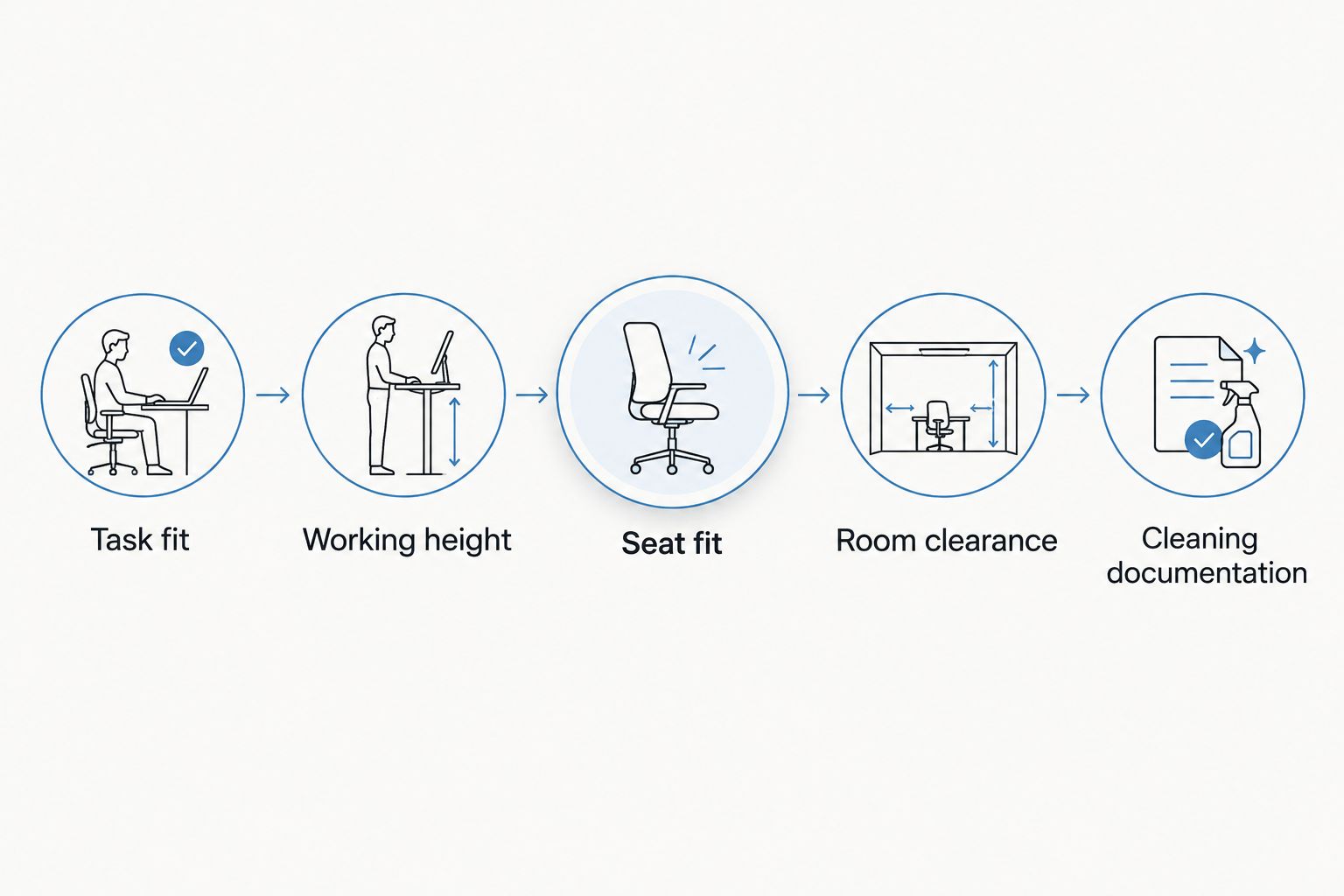
Define your patient-facing and charting tasks
Observe your current workflow before opening a product catalog. Write down where you sit, what you reach for, and when you leave the stool; include the transitions rather than recording only the seated portion of the task.
A short patient-facing interaction and a documentation session need separate checks. For patient access, examine whether your knees, stool base, and any back or arm supports limit positioning. For charting, check the keyboard and screen relationship instead of assuming the same stool setting works unchanged.
Ask a colleague to observe the setup with you. A second viewpoint helps identify the moment you start reaching around furniture or rotating away from your work, without turning an informal observation into a clinical assessment.
- List your patient-facing seated tasks.
- Record where you complete documentation.
- Identify repeated sitting-to-standing transitions.
- Note equipment you reach for while seated.
- Separate individual needs from shared-room requirements.
Measure your working height and foot support
Use a tape measure to record the examination surface, desk, and available knee space. Then compare those measurements with the candidate stool’s documented seated-height range; a cylinder description alone does not tell you the final seat height.
Check the complete setup while wearing your normal work footwear. You need usable foot support at the working position, not merely a stool that rises high enough. If a foot ring is part of the configuration, confirm where it sits relative to the seat and whether it interferes with access to equipment.
For a shared-room purchase in 2026, record the needs of each intended user. Do not assume that the tallest user’s preferred setting establishes an acceptable lower setting for everyone else.
- Measure the work surface from the floor.
- Record the current stool’s usable seated height.
- Request the candidate’s assembled seat-height range.
- Check foot support at the intended setting.
- Confirm knee clearance beneath the workstation.
Match the seat shape and supports to the task
Test your existing seating first, where its controls allow adjustment. Identify whether the problem is seat shape, limited adjustment, missing support, or furniture placement; buying another stool with the same constraint does not address the mismatch.
Sithealthier’s exam-stool selection includes saddle configurations and Surgeon Chairs. Use that range to compare distinct functions, not to assume that a more elaborate support assembly is better. A backrest provides a different contact point from an elbow support, and neither substitutes for suitable working height.
The Ergonomic Surgeon Chair with FootRest for Precision Surgical and Dental Work is a candidate for comparing a Surgeon Chair configuration with foot support. Keep it conditional on confirmed dimensions and task clearance; the name does not establish suitability for every procedure.
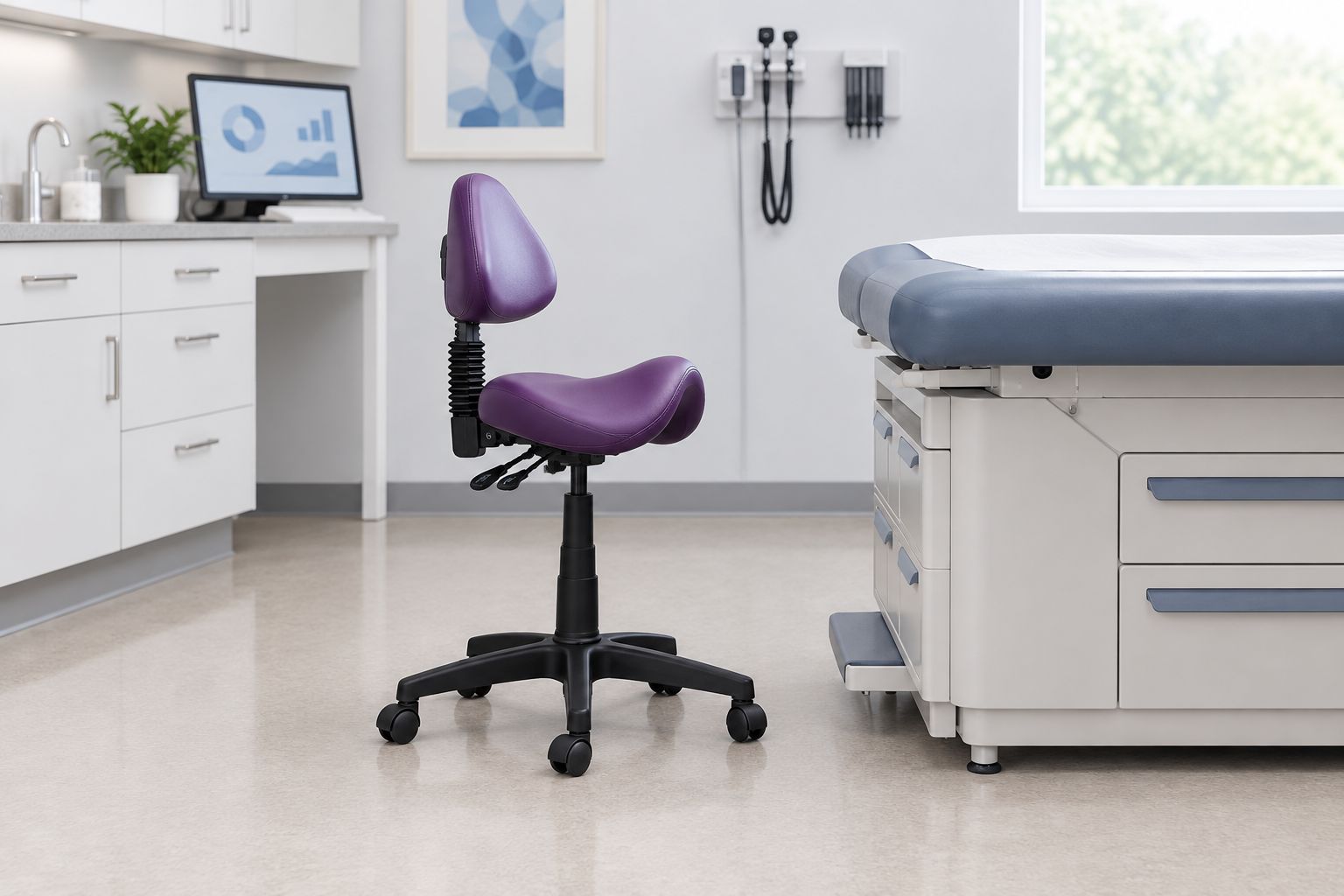
A saddle configuration also needs an individual fit check. Do not choose seat width from body height alone, and do not interpret a center gap as a guarantee of comfort.
- Compare single-seat and split-seat shapes.
- Check whether seat tilt is explicitly documented.
- Distinguish back support from upper-limb support.
- Confirm whether seat width is adjustable.
- Test entry and exit around attached supports.
Check movement and clearance in the actual room
Map the stool’s route manually before deciding on casters or a larger support configuration. Move your existing stool between its working and parked positions, then identify contact with cabinets, examination-table components, carts, or cables.
Ask for the candidate’s base dimensions and overall footprint. Seat dimensions alone leave out the parts most likely to meet furniture at floor level. A compact-looking seat is not proof of a compact assembled stool.
Check caster behavior separately from seat comfort. Confirm the wheel specification, floor suitability, and any braking function with the supplier; do not infer these details from a product photograph or the word medical.
- Measure the narrowest working passage.
- Check the base beside examination-table hardware.
- Identify a parking position outside circulation routes.
- Confirm caster suitability for your flooring.
- Check whether supports obstruct nearby drawers.
Verify cleaning documentation and product specifications
Review your clinic’s cleaning requirements before selecting upholstery. Match the chair manufacturer’s care instructions to the products and procedures your workplace uses; a wipeable surface description does not establish compatibility with every disinfectant.
Request written information for the exact model and configuration. Pay attention to seams, adjustment controls, backrest attachments, and arm-support joints, because each adds a surface your team must address during cleaning.
Treat capacity and dimensions as model-specific facts. A component rating or a similar-looking stool does not establish the complete chair’s rating. Keep the documentation with the purchasing record so later users do not have to reconstruct the original decision.
- Obtain upholstery and cleaning instructions.
- Confirm compatibility with your clinic’s cleaning products.
- Request assembled dimensions and adjustment ranges.
- Check the complete stool’s stated weight capacity.
- Record the exact model and selected configuration.
Compare candidates and document the final fit check
Build a simple comparison sheet before requesting purchasing approval. Mark each requirement as confirmed, unsuitable, or awaiting clarification; avoid giving an undocumented feature the same weight as a verified specification.
Sithealthier provides practical seating choices across budgets and help choosing the right fit. Send your task description and room measurements when asking for assistance, rather than asking only which stool is most ergonomic. The trade-off is straightforward: online comparisons cannot replace checking your own working position.
Complete the same task sequence for each candidate you can assess. Include patient access, charting, standing, and parking the stool, then record the reason for the selection rather than relying on a general comfort impression.
- Compare candidates against the same requirements.
- Resolve missing specifications before selecting a model.
- Check controls from the seated position.
- Include every intended user in shared-stool checks.
- Record the final configuration and fit decision.
Compare exam-stool options by task fit
Use this 2026 comparison as a shortlist framework, not a universal ranking. The stated features below come from the supplied product listings; exact height ranges, cleaning compatibility, and room fit still require confirmation for the selected configuration.
| Option | Best for | Documented feature or advantage | Key limitation or fit check |
|---|---|---|---|
| Ergonomic Surgeon Chair with FootRest for Precision Surgical and Dental Work | Comparing a Surgeon Chair configuration with foot support | Footrest named in the product listing | Confirm support layout and clearance before choosing it for a clinical task |
| USA Patented Twin Tiltable Saddle Stool with Adjustable Seat Width and Center Gap | Comparing adjustable-width split seating | Adjustable width and sitting angle | A center gap does not establish individual comfort; verify height range |
| Saddle Shape Stool with Back Support and Tilt-able Seat | Comparing saddle seating with back support | Adjustable back support and tiltable seat | Backrest position must fit both patient access and charting |
| Medical Ergonomic Stool with Chrome Base | Comparing backless seating for confined work areas | Backless design and small-frame description | No backrest; confirm the complete base footprint |
| Narrower Seat 360° Dynamic Motion Ergonomic Saddle Stool Holland Made | Assessing a narrower single-seat saddle | Listing describes a 13-inch seat | Narrower does not automatically mean suitable; check actual seated fit |
| Small Ergonomic Saddle Seat Stool for Petite Women | Checking a petite-user seating option | Description targets users approximately 5 feet 2 inches or shorter and 125 lb or less | These listing guidelines do not replace a height-range and seat-fit check |
| Heavy-Duty Split-Seat Saddle Stool, 500 lb Capacity | Comparing a higher-capacity split-seat option | Stated capacity of 500 lb | Capacity alone does not establish seat width, clearance, or cleaning suitability |
The best option is the configuration that meets your documented requirements with the fewest unresolved questions. Do not choose extra supports simply because they appear more substantial, or reject a straightforward backless stool when it fits the task better.
The two products below represent different configurations to investigate: a Surgeon Chair with a footrest and an adjustable-width twin saddle. Compare their full specifications against your checklist before selecting either.


Common mistakes medical assistants make when choosing stools
Choosing from the seat photo alone
A photograph does not establish working height, base clearance, or control access. For your 2026 shortlist, require assembled dimensions and a clear description of the selected configuration before treating a stool as a match.
Using the charting setup as the only fit test
A stool that fits a keyboard station still needs checking beside the examination table. Assess patient-facing access separately, especially when a backrest, foot ring, or upper-limb support changes the space around you.
Treating wipeable upholstery as cleaning approval
Wipeability and disinfectant compatibility are different questions. Obtain care documentation for the actual upholstery and confirm it against your workplace’s cleaning requirements before purchasing.
Buying one configuration for every staff member
Shared seating needs more than a usable upper height limit. Check the lower setting, seat shape, support position, and adjustment access for each intended user; do not assume that everyone can compensate with the same foot-ring setting.
Expecting the stool to correct the whole workstation
A stool cannot move an examination table, bring a keyboard closer, or clear a blocked working area. Adjust the surrounding setup where possible, and seek appropriate professional advice for persistent symptoms rather than treating a chair purchase as medical care.
FAQ
What are the best exam stools for medical assistants?
The best exam stools for medical assistants fit the clinical task, working height, user, and room. Compare seat shape, support configuration, movement, and cleaning documentation before selecting a model.
Is a saddle stool better than a regular medical stool?
A saddle stool is not automatically better than a conventional medical stool. Compare seated fit and patient access in the actual workspace; neither seat shape guarantees comfort or a health outcome.
Should a medical assistant choose an exam stool with a backrest?
Choose a backrest when its support position suits your seated tasks without obstructing access. Check it during patient-facing work and charting, because those positions need separate assessments.
Do medical assistants need a stool with a footrest?
Medical assistants need usable foot support at their working height, but not every setup requires an attached footrest. Check the selected stool height, floor contact, and any foot ring together.
Can a Surgeon Chair work in an exam room?
A Surgeon Chair belongs on an exam-room shortlist when its support configuration fits the intended task. Confirm overall dimensions, controls, cleaning requirements, and clearance rather than relying on its category name.
How do I check whether an exam stool is suitable for clinic cleaning?
Match the stool manufacturer's care instructions to your clinic's cleaning products and procedures. A medical label or wipeable upholstery description does not establish compatibility with every disinfectant.
Where can I compare saddle stools and Surgeon Chairs?
Sithealthier offers saddle stools, medical seating, and Surgeon Chairs for comparison. Use a written task-and-measurement checklist when requesting help, and confirm model-specific specifications before choosing.
One last thing
Check where the stool goes when nobody is sitting on it. A suitable working position is only part of the decision: the parked stool must also fit without blocking access to drawers, equipment, or circulation space.
Add a parked-position check to your 2026 purchasing record. It is a simple way to catch a room-fit problem that a seated comfort check leaves out.
Leave a comment