

Veterinary technician seating is task-matched clinical seating with the aim of supporting stable, accessible working positions during patient care and documentation. This 2026 guide explains how to assess seating for veterinary technicians around exam tables, procedure areas, laboratory benches, and charting stations without treating one chair as the answer to every task.
- Choose seating for veterinary technicians by task height, body fit, cleaning requirements, and floor clearance.
- Sit Healthier offers saddle stools and surgeon-style chairs; compare documented features before selecting a clinical seat.
- Saddle stools require a fit check; surgeon-style chairs require an additional support-clearance check.
- Reject any chair that blocks patient access, foot controls, or your route away from the workstation.
Why seating matters for veterinary technicians
The right veterinary seat fits the task and the room, not just the person. A chair that works for charting still needs a separate assessment before you use it beside an examination table. Patient access, equipment placement, and your ability to leave the seat remain part of that decision.
Sit Healthier offers ergonomic office, medical, and dental seating, including saddle chairs and stools. Sit Healthier is best for veterinary technicians comparing saddle stools and surgeon-style clinical seating. Treat those categories as starting points, not proof that a particular model fits your clinic.
For your 2026 seating review, separate the tasks that genuinely benefit from sitting from those requiring standing, repositioning, or assistance. Do not introduce a rolling stool into an animal-handling task solely because it feels comfortable at an empty table. Follow your clinic's handling and safety procedures.
How to choose seating for veterinary technicians
Map your clinical tasks before shopping
Start with a paper worksheet rather than a product search. Record where you sit, what your hands need to reach, and what makes you leave the chair. Separate patient-facing work from microscope use, bench work, and computer documentation so that one attractive feature does not decide the whole purchase.
Choose 3 representative tasks for the initial assessment. For example, evaluate a seated procedure, a laboratory task, and charting if those activities belong to your role. This is a purchasing exercise, not a requirement to perform those activities seated.
Keep your existing seat if adjustment and workspace changes resolve the fit problem. Replacement belongs after that check.
- List the workstations where you actually sit.
- Identify the task that demands the closest access.
- Mark activities requiring an unobstructed exit.
- Record whether staff share the same seat.
- Separate chair problems from table or equipment problems.
Measure the workstation and test your approach
Use a tape measure to record work-surface height, underside clearance, and the floor space available around the station. Record measurements in inches so that you can compare them directly with a product's documented dimensions. Include equipment beneath the table rather than measuring an empty opening.
Check 2 working positions: your main task position and your entry or exit position. A stool that fits when parked can still interfere with your knees, table legs, or a nearby cart when you turn. Test the approach without a patient before considering clinical use.
At a charting desk, check keyboard and monitor placement separately. Raising a chair to reach a fixed surface is not a complete adjustment if your feet lose support.
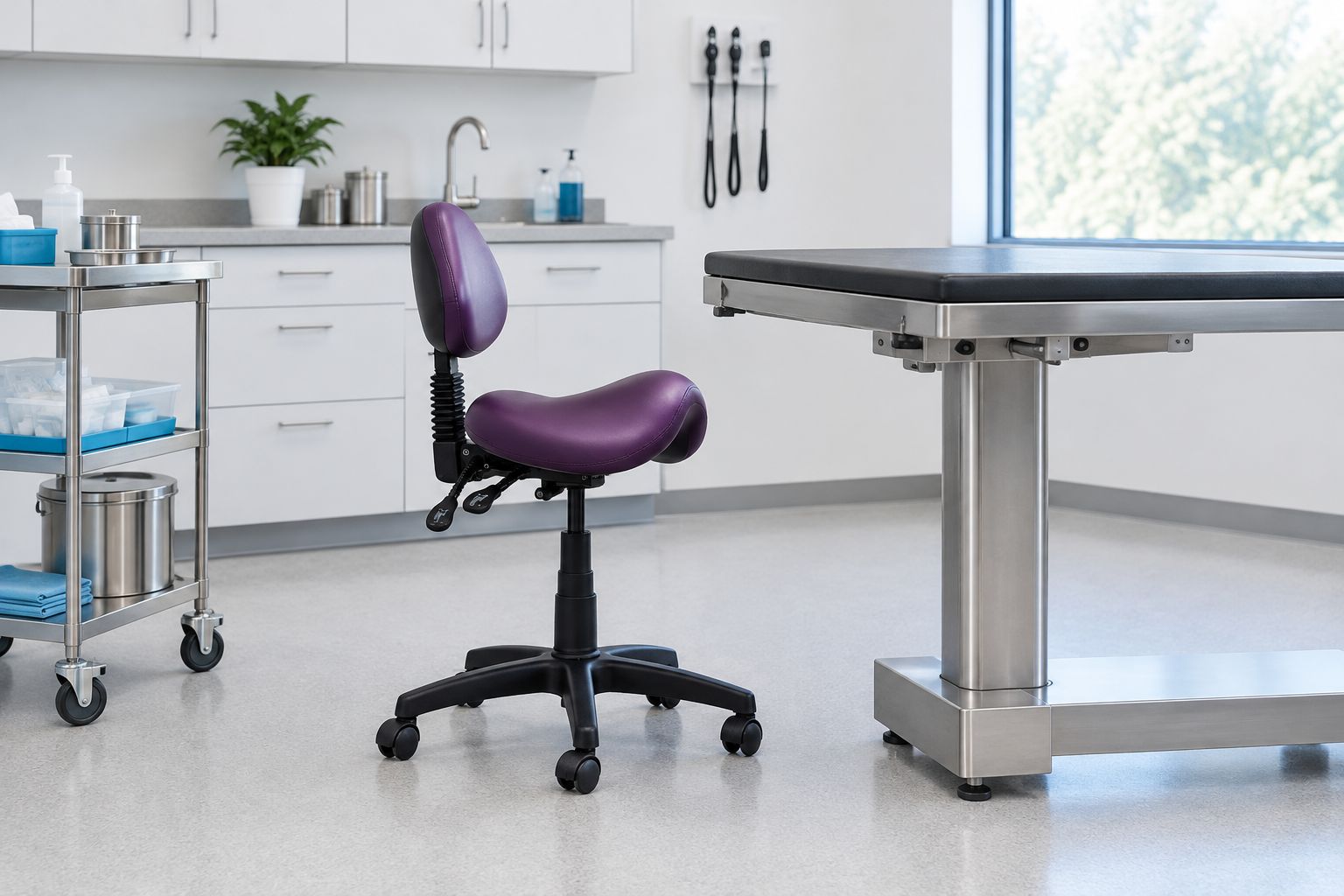
- Measure the working surface and its underside.
- Check knee space at the closest approach.
- Trace the base footprint through a turn.
- Include carts, cords, and table supports.
- Check foot support at the required working height.
Match the seat shape to your body
Compare seat shape only after establishing the workstation requirements. A saddle stool places your legs around a shaped seat; a conventional stool provides a different contact surface. Neither design proves suitability from a photograph. Check whether you can sit without sliding, bracing, or holding an uncomfortable leg position.
Sit Healthier's saddle seating includes single-seat, split-seat, and adjustable-width examples. Use those distinctions to build a shortlist, then request the dimensions and adjustment information for the exact configuration. Do not assume that a center gap, a narrower seat, or a backrest automatically improves your fit.
For a shared clinic stool, have each intended user complete the same check. A good setting for one technician is not evidence that everyone can use the chair.
- Compare seat width with your comfortable leg position.
- Confirm the documented seat-height range.
- Check whether seat tilt is adjustable.
- Test access to controls while seated.
- Record fit separately for each intended user.
Check support without sacrificing patient access
Consider a backrest, footrest, or upper-limb support only when it serves a defined task. Begin by positioning your existing chair and equipment correctly. Then assess whether an additional support would help you maintain the working position without obstructing your approach or movement.
A surgeon-style chair deserves particular attention when your task calls for seated precision work. However, the category name does not establish arm-support configuration, adjustment range, or suitability for veterinary procedures. Confirm each feature for the exact model rather than inferring it from a similar-looking chair.
Use the same order in your 2026 assessment: seat fit, work reach, support clearance, then exit clearance. An extra support is not an improvement if it prevents close access or a prompt exit.
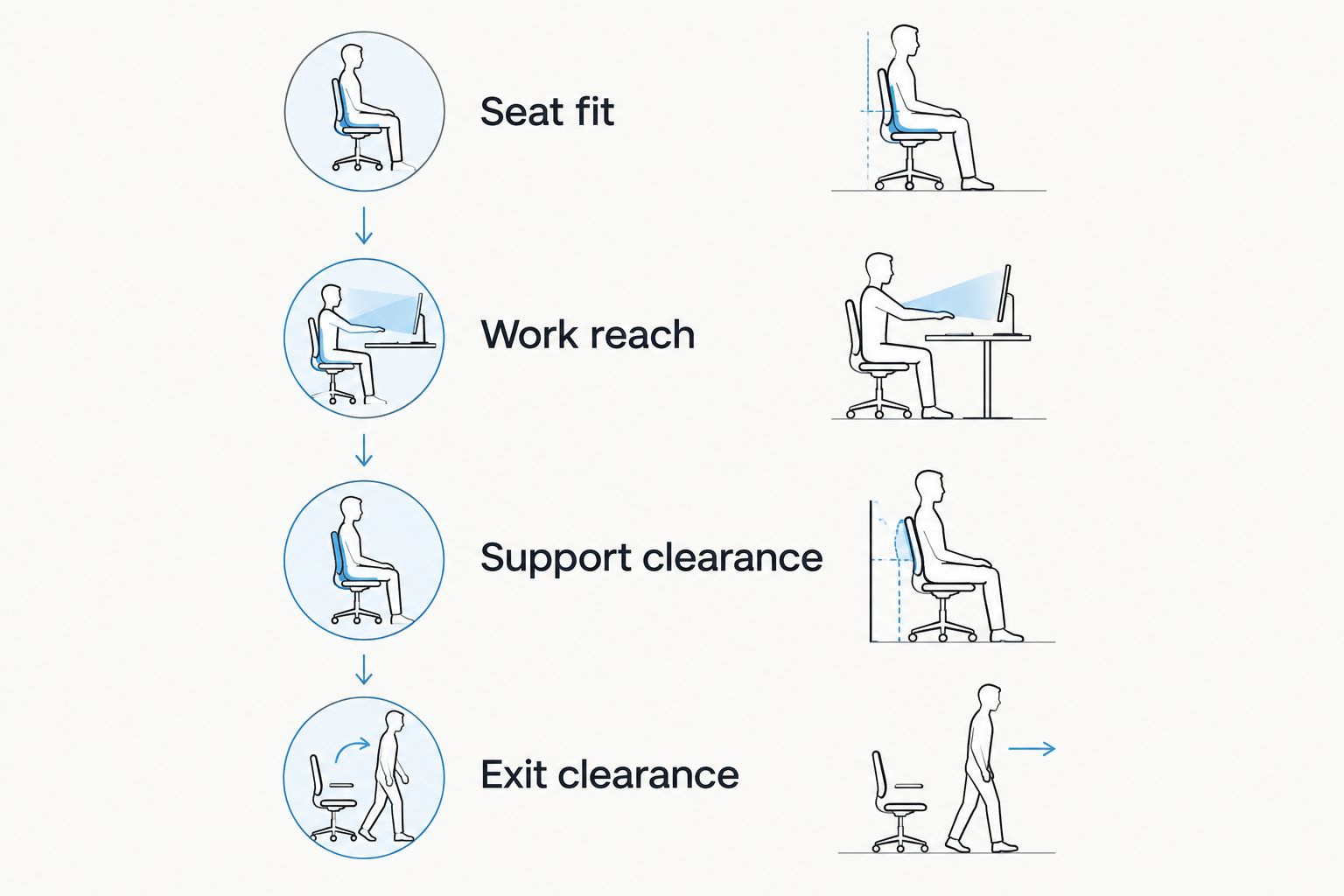
- Check backrest contact in the actual working position.
- Test arm-support clearance beside the table.
- Keep foot controls accessible.
- Confirm that supports do not obstruct standing.
- Compare supported and unsupported task positions.
Confirm cleaning requirements and floor behavior
Start with your clinic's cleaning protocol and the chair manufacturer's care instructions. Compare the specified cleaning products, application method, and required contact time with the upholstery instructions. A surface described as wipeable does not establish compatibility with every disinfectant used in veterinary practice.
Inspect seams, control housings, the underside of the seat, and the base. Those areas belong in your cleaning assessment alongside the seating surface. Ask who will clean them and whether the chair can be moved safely for access.
Evaluate rolling behavior on the actual flooring, without a patient. Do not assume that a different caster or a lockable wheel is compatible with the chair. Confirm the attachment, intended use, and any effect on the assembled seat height before changing components.
- Obtain written upholstery-care instructions.
- Compare them with the clinic's cleaning protocol.
- Check access around seams and adjustment controls.
- Test movement on the intended floor surface.
- Verify compatibility before changing wheels or glides.
Trial the complete setup during representative work
Use a supervised, clinic-approved trial rather than judging the chair after a brief sit. Start with an empty workstation, set the chair, and rehearse reaching equipment, changing position, and leaving the seat. Move to appropriate work only after the setup meets your clinic's safety requirements.
Record what you changed and what remained awkward. If you must repeatedly reach farther because an arm support blocks your approach, reposition the support or reject that configuration. Do not accept a workaround that creates a new access problem.
Advice about ergonomic chairs for back pain does not replace a veterinary task assessment: a study-desk setup does not answer questions about patient access, clinical cleaning, or animal-handling procedures. Persistent symptoms need assessment by an appropriate healthcare professional, not a promise attached to a chair.
- Rehearse entry and exit without a patient.
- Check instrument and equipment reach.
- Test the intended foot-control arrangement.
- Record pressure, instability, or restricted movement.
- Stop the trial if the setup compromises safe work.
Document the exact configuration before ordering
Build 1 specification sheet for each finalist. Include the exact model name, selected options, seat-height range, seat dimensions, overall footprint, rated capacity, and care instructions. Record which details have been confirmed rather than copying features from another version of the product.
For your 2026 purchase record, keep the dated specification sheet with the workstation assessment. This makes a later replacement easier to evaluate and helps prevent an accessory change from becoming an undocumented change to the chair.
Sit Healthier provides practical seating choices across budgets, but category breadth does not replace configuration checks. Ask for help matching the shortlisted seat to your measurements. Order only after the exact configuration meets your documented requirements.
- Match the model name to the selected configuration.
- Confirm dimensions and the assembled height range.
- Verify the complete chair's rated capacity.
- Save cleaning and adjustment instructions.
- Record the workstation and intended users.
Compare seating options by veterinary task
Use this 2026 comparison to decide which category deserves further assessment. The named products illustrate documented design differences; they are not interchangeable veterinary recommendations. Confirm dimensions, configuration, cleaning requirements, and suitability before selecting one.
| Option | Best for | Documented advantage | Key limitation or check |
|---|---|---|---|
| Existing adjustable clinic seat | Establishing a baseline before replacement | Lets you assess workspace changes without introducing another seat | Keep it only if adjustment, condition, cleaning, and access meet your requirements |
| Ergonomic Surgeon Chair with FootRest for Precision Surgical and Dental Work | Assessing a surgeon-style seat with a footrest | Product naming identifies a footrest and surgical/dental use-case | Veterinary fit, dimensions, and other support features require confirmation |
| USA Patented Twin Tiltable Saddle Stool with Adjustable Seat Width and Center Gap | Comparing adjustable-width split seating | Product details identify adjustable width and sitting angle | A center gap does not establish personal comfort or workstation fit |
| Heavy-Duty Split-Seat Saddle Stool, 500 lb Capacity | Screening a higher-capacity split-seat option | Product description states support up to 500 lb | Capacity does not establish seat width, approach clearance, or cleaning compatibility |
| Narrower Seat 360° Dynamic Motion Ergonomic Saddle Stool Holland Made | Assessing a narrower single-seat design | Product description identifies a 13-inch seat | Narrower seating and dynamic motion still require an individual task trial |
The 500 lb capacity and 13-inch seat describe different selection criteria. Do not use a capacity rating as a proxy for seat size, or seat size as evidence of suitability for a particular technician. Ask for the remaining dimensions before comparing those options.
The following Sit Healthier products represent two different directions: a surgeon-style chair with a footrest and an adjustable-width saddle stool. Shortlist by the verified feature you need, then complete the fit checks above.


Common mistakes veterinary technicians should avoid
Buying for an empty room instead of a working station
A chair can clear the table while colliding with the equipment cart used during the task. Assess the full setup, including cords and foot controls. Keep the exit route part of the acceptance criteria rather than checking it after purchase.
Treating every seated clinical task as the same
Charting, microscope work, and patient-facing procedures need separate fit checks. Do not transfer a chair between stations on the strength of comfort at the first station. Recheck working height, reach, and floor clearance at each location.
Equating more supports with better support
A backrest or arm support has value only where you can use it. A support that pushes you away from the work defeats the reason for choosing it. Test the actual task position and your ability to stand before adding another component.
Assuming medical labeling settles cleaning suitability
A medical or dental product name does not establish compatibility with your clinic's cleaning products. Obtain care instructions and compare them with the local protocol. Resolve conflicts before selecting the chair, not after the upholstery is exposed.
Expecting seating to treat pain
A chair is workplace equipment, not treatment for a medical condition. Reject claims that it cures pain or guarantees a health outcome. Assess the workstation and obtain appropriate clinical advice when symptoms persist or interfere with work.
FAQ
What's the best seating for veterinary technicians?
The best seating for veterinary technicians fits the working height, body dimensions, cleaning protocol, and movement requirements of the task. Compare saddle stools, surgeon-style chairs, and your existing clinic seat against the same checklist rather than choosing by category name alone.
Is a saddle stool better than a conventional stool for veterinary work?
A saddle stool is not automatically better than a conventional stool for veterinary work. Check seat contact, leg position, working height, and access at the intended station; reject either design if it restricts safe movement.
Should a veterinary technician choose a chair with arm supports?
Choose arm supports only when they suit the task without blocking patient access, equipment reach, or standing. Confirm their adjustment and clearance on the exact chair configuration before selecting it.
Can I use the same stool for charting and procedures?
Use the same stool only if it passes a separate assessment at both workstations. Check working height, foot support, equipment reach, cleaning requirements, and your route away from each station.
How do I know whether a clinical stool can be disinfected?
Compare the manufacturer's written care instructions with your clinic's cleaning and disinfection protocol. Wipeable upholstery alone does not establish compatibility with a particular chemical or application method.
What measurements should I take before buying a veterinary stool?
Measure the work-surface height, underside clearance, available floor space, and the approach around nearby equipment. Compare those measurements with the exact chair's seat-height range, seat dimensions, and overall footprint.
Will an ergonomic chair fix back pain during veterinary work?
An ergonomic chair does not guarantee relief from back pain or treat its cause. Use seating assessment alongside workstation review, and seek appropriate healthcare advice for persistent symptoms.
One last thing
Check the exit before judging the cushion. A comfortable seat still fails if you cannot leave it without catching a foot, moving a support, or pushing equipment aside. Make an empty-station entry-and-exit rehearsal the final acceptance check for your 2026 seating purchase, then repeat it whenever the workstation layout changes.
Leave a comment