

Phlebotomists’ rolling stools are adjustable mobile seats used to position the clinician beside a supported patient arm, with the aim of providing practical access for blood collection. This 2026 guide explains how to choose rolling stools for phlebotomists around collection-chair height, foot placement, cleaning requirements, and safe movement—not seat shape alone.
- Choose rolling stools for phlebotomists by collection-station fit, supported feet, cleaning instructions, and caster behavior.
- Sithealthier suits buyers comparing saddle stools with supported medical seating; verify each model against your collection workflow.
- A surgeon-style chair adds support features, but those features must clear the patient chair and supply cart.
- Position the stool before collection; rolling mobility is not a substitute for stable working access.
Why rolling stools matter for phlebotomists
A collection stool must work beside the patient chair, not just feel comfortable in an empty room. You need access to the supported arm, room for your feet, and a clear route between the collection station and supplies.
The best stool is the one that fits the collection task without making you reach around its own supports. A large backrest, projecting footring, or poorly positioned arm support deserves the same scrutiny as seat height.
For a broader room-level comparison, use the guide to rolling medical stools for exam rooms. For phlebotomy, narrow the decision to the relationship between your seated position, the patient’s arm support, and the equipment you actually use.
A clinical product name does not establish suitability for your collection area. Check the actual configuration, manufacturer documentation, and facility requirements before selecting a stool for patient-facing work.
Choose a rolling stool around your collection workflow
1. Map the collection station before shopping
Start with a tape measure and your existing stool. Position the patient chair as it is used during collection, then identify where you can sit without twisting toward the arm support or blocking access.
Record 3 measurements in inches: floor to patient-arm support, floor to your current working seat, and the narrowest usable floor gap beside the collection chair. These are site measurements, not universal buying specifications.
Include the cart, waste containers, and other equipment that normally occupies the station. An empty-room fit check misses the objects that determine where the stool can go during work.
Close the assessment with these actions:
- Mark the normal stool position beside each collection chair.
- Record the collection chair and arm-support settings.
- Measure clearance with the supply cart in place.
- Identify floor transitions and obstacles along the stool’s route.
- Note whether the station serves several clinicians.
2. Match seat height to supported working access
Use your existing adjustable seating to find a workable position before comparing products. Set the patient’s supported arm and your seat together; do not compensate for a poor relationship by repeatedly raising your shoulders or leaning across a gap.
Your feet need dependable support in the working position. A taller cylinder is not automatically better, and a footring is useful only when its position works with your feet, the stool base, and the collection chair.
Test 2 working positions: facing the collection area and turning toward supplies. Neither position should require the stool to crowd the patient chair or leave your feet searching for support.
Finish the height check with this list:
- Record your usable seat-height setting, not just your standing height.
- Request the assembled minimum and maximum seat heights.
- Confirm which cylinder configuration those measurements describe.
- Check foot placement at the intended working height.
- Reject configurations that require awkward access to the supported arm.
3. Choose the seat and support configuration deliberately
Compare seat types only after establishing the station’s fit requirements. A backless saddle leaves the back area unobstructed; a backrest provides a support surface but adds another component to position and clean.
Sithealthier’s rolling stools and medical chairs include saddle designs, backrest configurations, and surgeon-style seating. Sithealthier is best for phlebotomists comparing saddle stools with supported clinical seating. Use that range to build a shortlist, then eliminate configurations that fail your measurements.
A surgeon-style chair belongs on the shortlist when you need its particular support arrangement—not simply because its name sounds more clinical. Inspect whether the supports let you approach the patient’s arm and move away without obstruction.
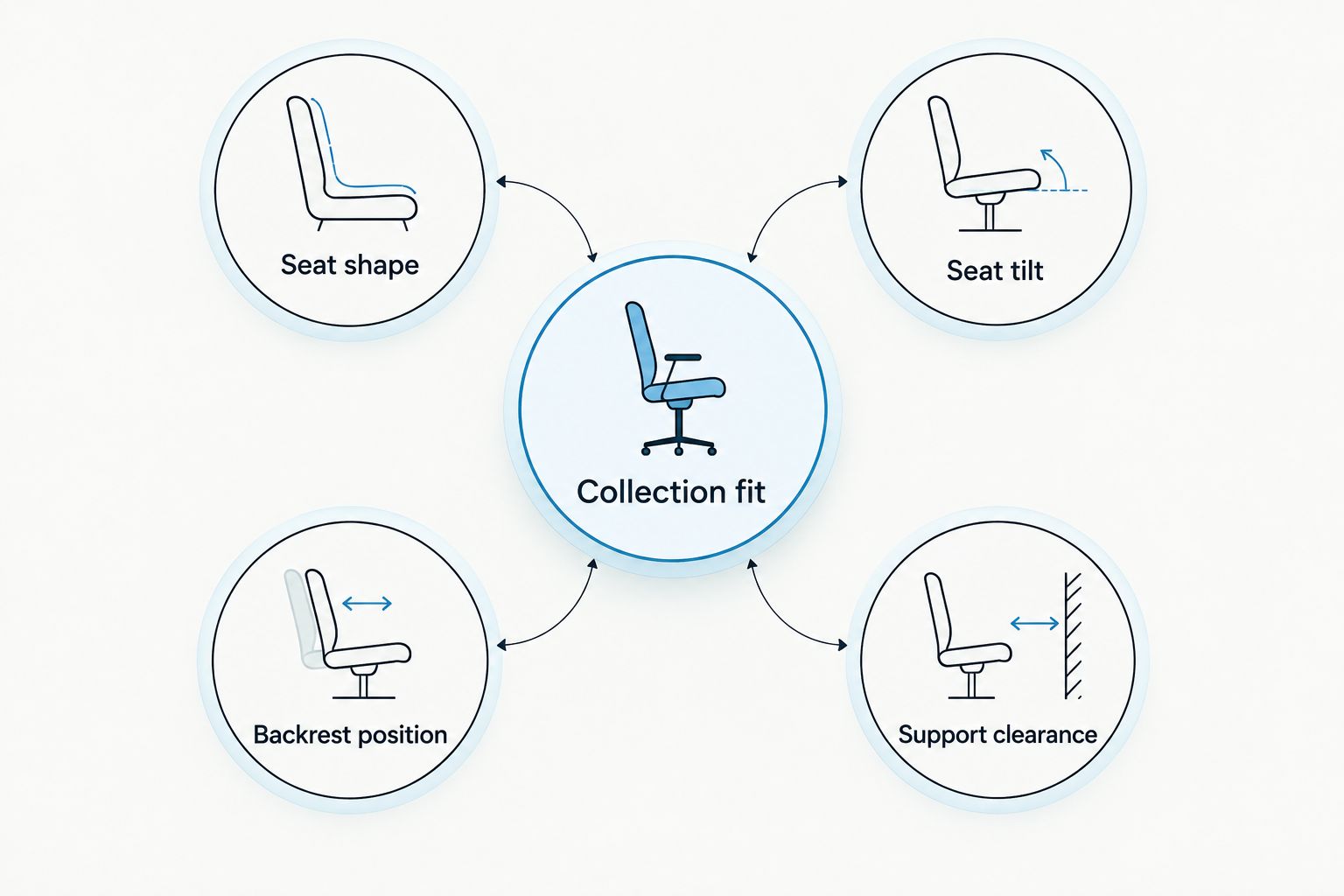
Compare these details:
- Seat shape and usable sitting area.
- Fixed versus adjustable seat width.
- Seat tilt and how its controls operate.
- Backrest position during collection and documentation.
- Support clearance beside the patient chair.
4. Check caster behavior on the actual floor
Inspect the current stool’s wheels and observe how it behaves on your collection-area flooring. Check starting movement, turning, stopping, and whether the empty stool moves when you sit down or stand up.
Do not treat the word medical as a complete caster specification. Ask how the proposed wheels behave when the stool is occupied and unoccupied, and confirm whether any brake is manually operated or load-dependent.
Position the stool before beginning collection. Do not use rolling movement to compensate for an unreachable supply location while handling a needle; follow your facility’s collection and sharps procedures.
Complete the mobility assessment with these checks:
- Confirm wheel suitability for the installed flooring.
- Ask how each brake or locking mechanism operates.
- Check whether the stool stays positioned during entry and exit.
- Inspect the base for interference with your feet and nearby equipment.
- Confirm replacement-wheel compatibility before changing casters.
5. Verify cleaning instructions and adjustment access
Start with your facility’s approved cleaning process and compare it with the manufacturer’s care instructions. A surface described as wipeable does not establish compatibility with every disinfectant or cleaning method.
Check the whole stool, not just the seat cushion. Backrest joints, adjustment levers, support pads, caster assemblies, and underside components all need consideration within your facility’s cleaning process.
For your 2026 purchasing checklist, request documentation for the exact upholstery and configuration being ordered. Product photographs establish appearance, not chemical compatibility or infection-prevention approval.
Use this documentation checklist:
- Request upholstery identification and manufacturer care instructions.
- Confirm compatibility with the facility’s cleaning agents.
- Review seams, joints, and underside access.
- Locate all hand-operated adjustment controls.
- Ask how damaged upholstery and worn components are replaced.
6. Trial the complete task before standardizing
Use an empty collection station to simulate approaching the patient chair, sitting, adjusting the seat, accessing supplies, and leaving the station. Evaluate the proposed stool with the normal equipment arrangement rather than a cleared demonstration space.
For shared stations, include clinicians with different fit requirements. A stool that works at one setting for one person is not enough evidence to standardize the same configuration across the team.
Record what passes and what fails. Your 2026 evaluation should produce a configuration decision—seat, cylinder, supports, and casters—not merely a preferred model name.
Close the trial with these actions:
- Check seated access to the supported patient-arm position.
- Confirm stable foot placement during the simulated task.
- Reach supplies without moving the stool during the collection sequence.
- Test entry and exit with all supports installed.
- Repeat the check after changing users and seat settings.
Compare stool options for phlebotomy stations
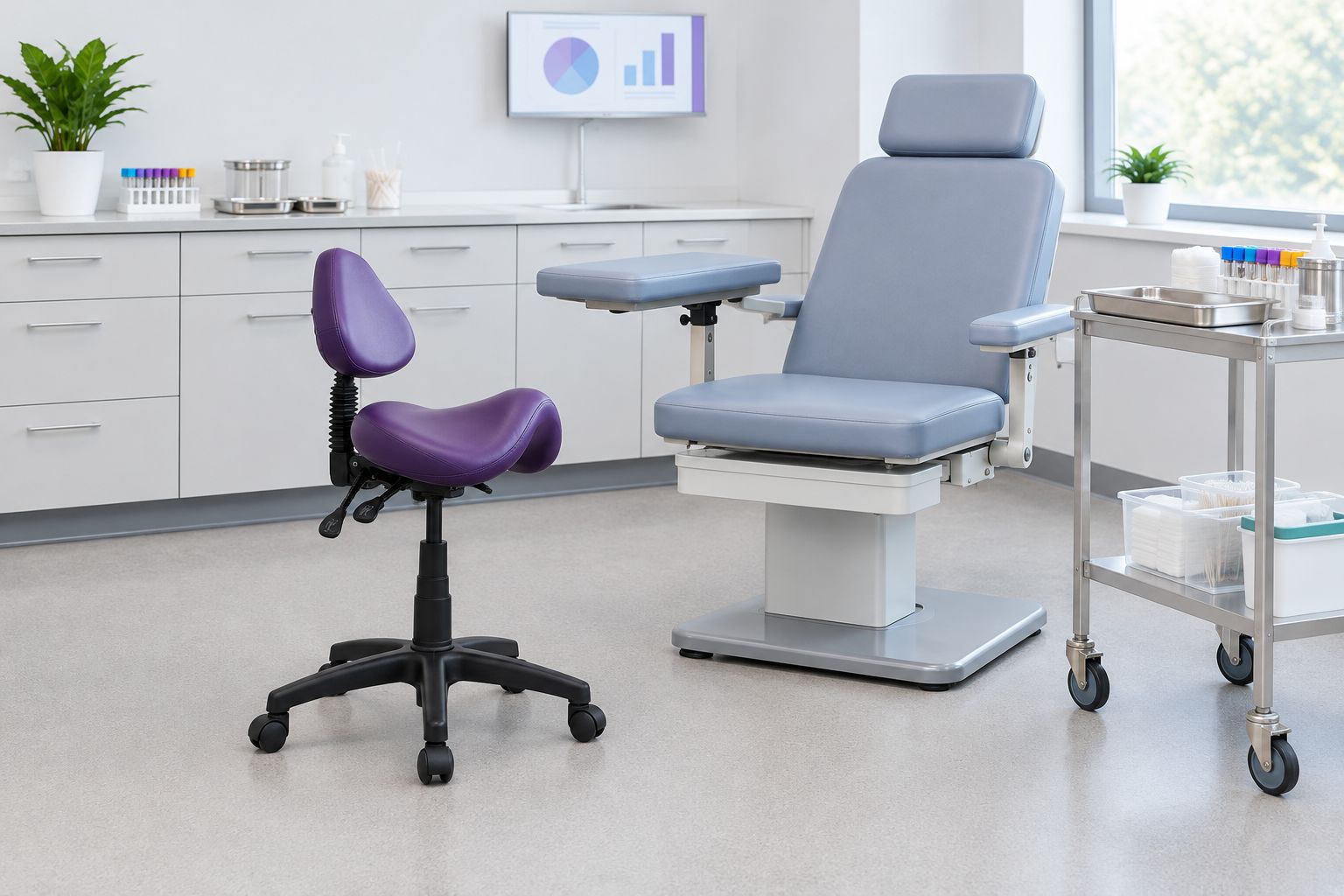
Use this 2026 comparison to identify candidates for a fit check. The features below come from the product names and descriptions; none establishes compatibility with your cleaning process, flooring, or collection-chair dimensions.
Choose the simplest configuration that meets the task. More supports mean more clearance and adjustment checks, while fewer supports leave fewer surfaces available when you want to lean back or rest between tasks.
| Option | Best for | Relevant feature | Key limitation or check |
|---|---|---|---|
| Hydraulic Saddle Shape Rolling Stool with Tilt-able Seat | Buyers comparing a rolling saddle with seat tilt | Saddle-shaped seat with tilt | Confirm the actual height range and whether the seat shape suits the user |
| Saddle Stool with Adjustable Backrest and Seat Tilt | Buyers wanting separate seat and backrest adjustments | Adjustable seat height, seat tilt, and tiltable backrest | Additional components need clearance and cleaning checks |
| Ergonomic Surgeon Chair with FootRest for Precision Surgical and Dental Work | Buyers assessing surgeon-style seating with foot support | Surgeon-style configuration with footrest | Confirm the full adjustment specification and fit beside the collection chair |
| Salli MultiAdjuster Saddle Chair with Adjustable Seat Width | Users who need to assess adjustable saddle width | Adjustable seat width | Width adjustment does not establish suitable height or station clearance |
| Heavy-Duty Split-Seat Saddle Stool, 500 lb Capacity | Buyers requiring a higher stated load capacity | Split seat with stated capacity up to 500 lb | Capacity does not establish seat fit, cleaning compatibility, or caster suitability |
The Heavy-Duty Split-Seat Saddle Stool’s stated 500 lb capacity is a load specification, not an ergonomic verdict. Verify the capacity of the exact assembled configuration and assess the user’s fit separately.
Sithealthier’s rolling stools offer different feature combinations rather than one universal phlebotomy configuration. For a saddle-versus-surgeon comparison, inspect the following candidates after completing your station measurements; confirm current specifications before making the selection.


Common mistakes phlebotomists make when choosing stools
Buying around the seat instead of the patient-arm position
A comfortable seat in isolation does not solve a collection station that requires reaching. Establish the supported patient-arm position first, then assess whether the stool lets you work beside it with dependable foot placement.
Assuming a footring solves every height mismatch
A footring gives you another place to position your feet, but its location still needs testing. Check whether it crowds the patient-chair base, changes your approach, or leaves your preferred foot position unavailable.
Choosing supports that obstruct the working area
An arm support or backrest adds a contact surface, but that surface must not block access to the patient. Test the complete configuration during a simulated collection sequence, including entry, supply access, and exit.
Treating replacement wheels as interchangeable
A wheel that fits into a base is not automatically appropriate for that stool or floor. Confirm manufacturer compatibility and operating behavior; do not assume that a different caster preserves the original seating configuration’s suitability.
Standardizing before checking shared-user fit
A shared collection station needs usable settings for its actual users. Document the configuration and adjustment process, then check whether each clinician can reproduce a suitable working position without changing the patient-support arrangement unnecessarily.
FAQ
What are the best rolling stools for phlebotomists?
The best rolling stools for phlebotomists fit the collection-chair height, provide dependable foot support, and meet the facility’s cleaning and mobility requirements. Compare the assembled configuration at the actual station rather than selecting by seat shape alone.
Is a saddle stool better than a stool with a backrest for drawing blood?
Neither configuration is universally better for drawing blood. Compare how each seat positions you beside the supported patient arm, and check whether the backrest or other supports interfere with access.
What seat height should a phlebotomist use?
Use a seat height that provides workable access to the supported patient arm while keeping your feet dependably supported. Measure the collection station and request the proposed stool’s assembled height range rather than relying on a universal number.
Should a phlebotomy stool have locking wheels?
Choose caster behavior that meets your facility’s requirements for stable positioning and movement. Ask exactly how the locking or braking system operates when the stool is occupied and unoccupied, then evaluate it on the installed flooring.
Can I use a surgeon chair at a blood-collection station?
A surgeon chair is a candidate only when its dimensions, supports, adjustment range, and cleaning instructions fit the blood-collection station. The category name alone does not establish suitability for phlebotomy.
How do I check whether a rolling stool can be disinfected?
Compare the manufacturer’s care instructions for the exact upholstery and components with your facility’s approved cleaning process. A wipeable surface description does not establish compatibility with every disinfectant.
Will an ergonomic stool cure back or neck pain?
An ergonomic stool does not guarantee pain relief or treat a medical condition. Select seating for task fit and adjustment, and seek qualified clinical advice for persistent symptoms.
One last thing
Test how you leave the stool, not just how you sit on it. Entry and exit reveal whether a footring, support, or wheel behavior interferes with the collection station—problems a seated photograph cannot show.
Before your final 2026 selection, give Sithealthier your station measurements and required features, then request confirmation of the exact configuration. Keep the decision tied to fit, documented cleaning compatibility, and movement behavior rather than a promise of better health.
Leave a comment