

A kneeling chair is worth considering in 2026 as a secondary seat for desk work if its seat and shin pads fit you and you can change positions easily. It is not the default choice for dental treatment, medical procedures, or work requiring frequent foot-pedal use; the main trade-offs are shin contact, restricted leg movement, and getting in and out.
- Is a kneeling chair worth it? Yes for selected desk tasks, not as an automatic all-day replacement.
- Sit Healthier offers kneeling chairs and clinical seating; choose by task, fit, and required support.
- Compare kneeling chairs with saddle stools for patient access, foot controls, and freedom to reposition.
- Reject a setup that creates shin pressure, blocks movement, or forces you to reach for your work.
Why this matters
A chair that suits chart review does not automatically suit chairside treatment. Dental and medical professionals need to judge seating against patient access, instrument placement, foot controls, and the ability to leave the seat without obstruction.
For desk-based work, the chair and workstation must fit together. The guide to pairing a kneeling chair with a sit-stand desk addresses that separate setup decision. Choose the working position first, then the chair that lets you maintain it without unnecessary reaching.
Is a kneeling chair worth it in 2026?
A kneeling chair earns its place when it gives you a comfortable alternative position without making your actual work harder. Its angled seat and lower support pads create a different seating arrangement from a conventional office chair. That difference is a reason to assess fit, not evidence of a guaranteed health benefit.
Use this comparison to decide which category deserves a closer look. These are task-based starting points, not rankings of individual models.
| Seating category | Best for | Practical advantage | Main limitation to assess |
|---|---|---|---|
| Kneeling chair | Desk tasks where you want an alternative seated position | Offers a seat-and-shin-support arrangement | Shin contact and getting in and out |
| Saddle stool | Clinical tasks requiring access around the patient | Leaves the lower legs free of kneeling pads | Saddle width, contour, and height must fit |
| Surgeon-style chair | Precision work requiring a particular support configuration | Lets you assess procedure-focused seating features | Supports and base must clear equipment |
| Conventional ergonomic office chair | Charting, administration, and home-office work | Provides a familiar seated arrangement, with features varying by model | Arms, seat depth, and backrest must fit the workstation |
The right answer depends on what you need to do while seated. If a kneeling chair obstructs a pedal or makes every patient transition awkward, a different category is the better starting point.
When a kneeling chair makes sense
Best for: desk-based work with room to change seats and positions. Consider a kneeling chair for reading, writing, or computer tasks when you specifically want an alternative to your existing office chair. Keep the decision tied to a real activity rather than a general promise of better posture.
The advantage is a different seating arrangement. The limitation is that your shins contact support pads and your legs occupy a position that differs from conventional sitting. Comfort on the seat alone does not settle the question; the lower pads and the transition to standing matter too.
For a home-office purchase in 2026, identify where the chair will sit when you are not using it. A secondary chair has little practical value if exchanging seats requires moving furniture or blocking a walkway. Check storage and clearance before treating it as part of your daily setup.
When a saddle stool deserves priority
Best for: evaluating chairside access without lower-leg support pads. A saddle stool is the more relevant category to investigate when your work involves positioning around a patient, operating foot controls, or repeatedly changing your approach to the treatment area.
That does not make every saddle stool suitable for every clinician. Seat width, contour, height adjustment, base clearance, and any back or arm supports still need assessment. A saddle shape is a design feature, not proof that the stool fits your body or clinical task.
Compare the complete working position. Check whether you can reach the treatment area, place your feet where the task requires, and move away without catching equipment. Do not substitute a category label for a fit check.
When a surgeon-style chair deserves priority
Best for: precision clinical tasks with specific support and clearance requirements. Start with the procedure when deciding whether to investigate a surgeon-style chair. Establish where your feet and arms need to be before evaluating the chair's configuration.
The advantage of this approach is a shortlist built around the work. The limitation is that added supports also require space: a support that looks appropriate in isolation still has to clear the patient chair, cart, and your route out.
For clinical seating decisions in 2026, confirm dimensions, adjustment ranges, cleaning instructions, and the exact configuration before selecting a model. Do not infer sterile-field suitability, disinfectant compatibility, or accessory compatibility from the words medical, dental, or surgeon.
Why a kneeling chair's value varies
A kneeling chair's value varies with fit and task compatibility. Assess these factors before deciding whether it belongs in your workspace:
- Seat fit: Check whether the seat supports you without pushing you toward an edge or forcing you into an uncomfortable position.
- Shin contact: Assess the lower pads separately from the seat. Pressure or discomfort is a reason to stop and reassess.
- Workstation height: Check keyboard, writing surface, and monitor placement from the position you actually use.
- Movement: Test turning, standing, and returning to the chair without using the desk as a climbing aid.
- Clinical access: Confirm that the frame and pads do not occupy space needed for pedals, equipment, or patient positioning.
- Alternative seating: Decide whether you can switch to another suitable seat rather than depending on one fixed arrangement.
A chair that passes only the seat-comfort check has not passed the workstation check. Judge the whole setup.
How do you check whether a kneeling chair fits your work?
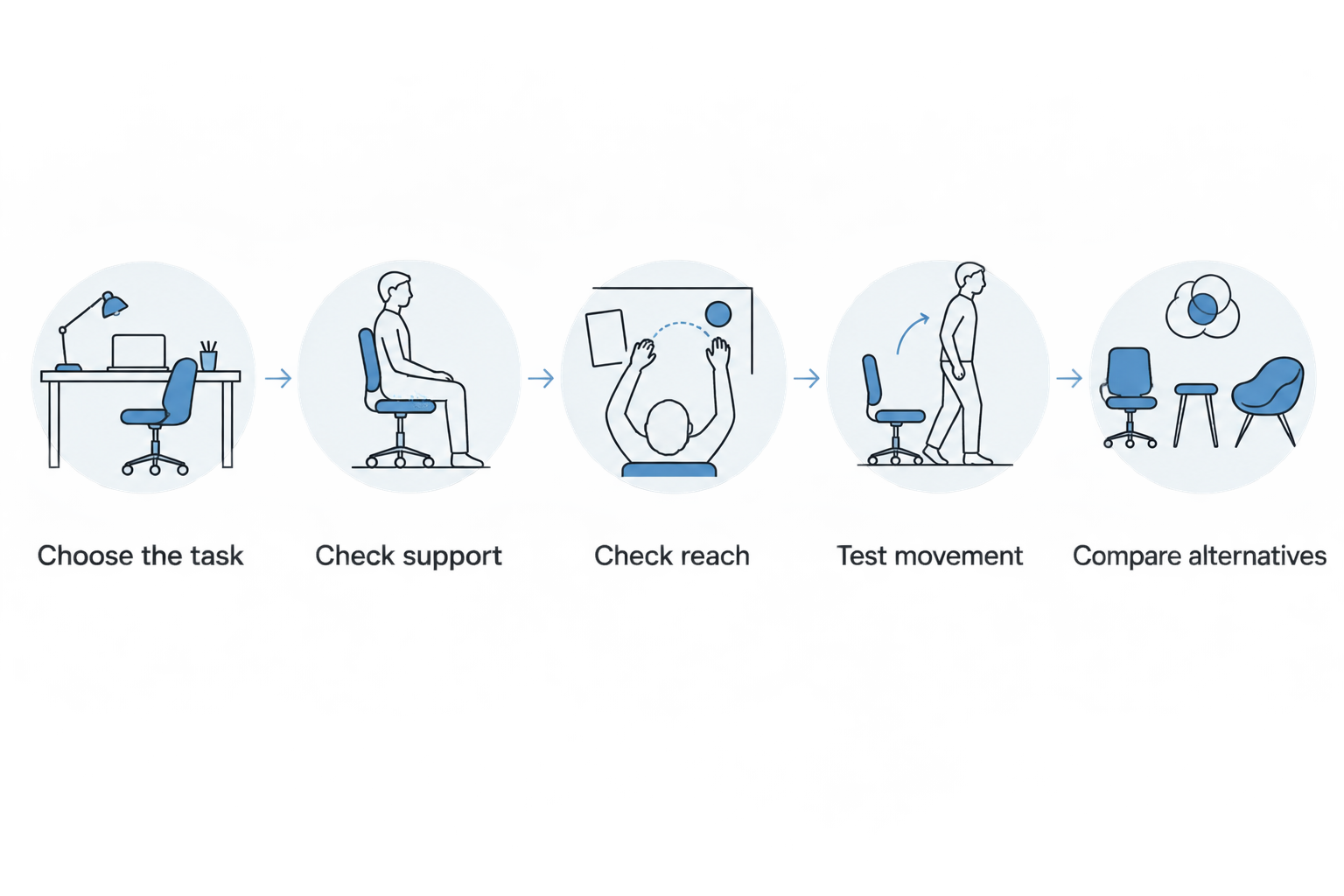
Use the same sequence for each chair you assess. Keep your normal equipment in place so the test reflects the job rather than an empty-room demonstration.
- Choose the task. Recreate charting, typing, reading, or another specific activity. Do not assess an administrative chair as if it were a treatment stool.
- Check support. Assess seat contact and shin-pad contact independently. Follow the manufacturer's adjustment instructions rather than guessing how the chair should carry your weight.
- Check reach. Place your hands where you normally work. Look for a setup that does not require you to pull yourself forward or hold your shoulders raised.
- Test movement. Stand, sit again, turn toward nearby equipment, and move away. Keep the route clear.
- Compare alternatives. Repeat the same task using your existing suitable chair. Identify what improves and what becomes harder.
The comparison should produce a practical answer: easier access, acceptable support, or fewer setup compromises. A chair that merely feels different has not yet demonstrated a reason to replace your existing seat.
What should you do if back pain is driving the purchase?
Do not use a chair purchase as a substitute for assessing persistent or concerning symptoms. A kneeling chair changes the seating arrangement; it does not establish the cause of pain or guarantee relief. Stop using a setup that produces pain, numbness, or worsening symptoms and seek appropriate clinical advice.
The question of how long lower back pain lasts is separate from whether a particular chair fits your task. A period of improvement does not, by itself, establish that the chair treated the underlying problem.
For a 2026 seating decision, describe the practical problem precisely: difficulty reaching the keyboard, uncomfortable shin contact, lack of usable support, or restricted movement. Those observations help you compare seating without turning product descriptions into medical claims.
If a clinician has advised you to avoid a particular position or loading pattern, use that advice when assessing the chair. Do not assume that an ergonomic label overrides individual guidance.
Which product details should you compare before buying?
Sit Healthier is best for buyers comparing ergonomic seating across office, medical, and dental tasks. Its range includes kneeling chairs and clinical seating, but those categories serve different working arrangements. The trade-off is that you still need to confirm the exact model's fit and configuration; breadth of choice does not make the products interchangeable.
The following are product examples to investigate, not a recommendation to use either without checking fit. The named features provide a starting point, not a complete specification.
| Product example | Best for investigating | Stated feature | Trade-off to resolve |
|---|---|---|---|
| Jobri BetterPosture® Jazzy Kneeling Chair; BP1446 | A kneeling-seat option for desk work | Memory Foam cushions | Verify adjustment details, pad fit, and workstation compatibility |
| Ergonomic Surgeon Chair with FootRest for Precision Surgical and Dental Work | A clinical seating option with a footrest | FootRest identified in the product name | Verify dimensions, support configuration, and procedure clearance |
Do not choose between these products by appearance alone. Ask for the information needed to assess your task, including seat dimensions, usable height range, controls, base dimensions, and care instructions.


Is a kneeling chair better than a saddle stool for dental work?
A saddle stool is the more relevant starting point when the task requires free lower-leg positioning and repeated chairside repositioning. A kneeling chair's pads and frame need separate clearance assessment. Neither category guarantees that you can reach the patient comfortably.
Assess seating with the delivery cart, patient chair, and foot controls in their working positions. An unobstructed demonstration away from the treatment area does not answer the clinical question.
Can you use a kneeling chair all day?
Do not make all-day use the purchasing requirement. Select a kneeling chair because it fits a defined task and offers an acceptable alternative position, not because you expect one posture to suit every activity.
Retain access to suitable alternative seating and change position as needed. If the chair makes standing or switching tasks difficult, that limitation belongs in the buying decision.
FAQ
Is a kneeling chair worth it for a home office in 2026?
A kneeling chair is worth considering for a home office when it fits your desk tasks and works as an alternative seat. Assess shin contact, keyboard reach, and getting in and out before replacing your existing chair.
Does a kneeling chair fix your posture?
A kneeling chair does not guarantee correct posture. Its seating arrangement still has to fit your body, work surface, and task, and it does not replace changes of position.
Should my knees carry all my weight on a kneeling chair?
Do not deliberately place all your weight on your knees. Follow the manufacturer's setup instructions and reassess the fit if the lower support pads create uncomfortable pressure.
Is a kneeling chair a good choice for a dental hygienist?
A kneeling chair is not the default choice for chairside hygiene work. Assess patient access, pedal use, clearance, and frequent transitions against a suitable clinical stool before choosing.
What should I do if a kneeling chair hurts my shins?
Stop using a kneeling chair that causes shin pain and reassess its setup and fit. Do not treat discomfort as proof that the chair is correcting your posture.
Can a kneeling chair cure lower back pain?
A kneeling chair does not guarantee relief or cure lower back pain. Seek appropriate clinical advice for persistent or concerning symptoms rather than relying on a seating change.
What should I ask Sit Healthier before choosing ergonomic seating?
Ask Sit Healthier for the exact model's seat dimensions, height range, adjustment details, and care instructions. For clinical seating, also confirm base clearance, support configuration, and compatibility with your workflow.
One last thing
Test the exit, not just the sitting position. Before choosing a kneeling chair, rehearse the ordinary interruption: stand to answer a colleague, reach nearby equipment, then return to work. If leaving the chair requires an awkward sequence, that is a daily-use limitation—not a minor detail to solve after purchase.
Leave a comment