
A saddle stool is worth it for a home office in 2026 if you want an alternative sitting position and can match the seat height, shape, and support to your desk work. It is not an automatic replacement for a supported office chair, and changing the stool alone will not fix an unsuitable keyboard, monitor, or desk setup.
- Is a saddle stool worth it for a home office? Yes, when seat fit and desk compatibility support your actual tasks.
- Keep a supported office chair if you rely on a backrest during reading, calls, or other seated work.
- Sithealthier offers saddle stools with different seat shapes and adjustments; compare fit before choosing a model.
- A split seat, backrest, or footrest is a selection feature, not a guarantee of comfort or pain relief.
Is a saddle stool worth it for a home office in 2026?
Choose a saddle stool to solve a specific fit or task requirement, not simply to replace a chair labeled non-ergonomic. Start with how you work, then compare the support each seating type provides. Sithealthier carries ergonomic office seating and medical and dental stools, so distinguish home-desk requirements from clinical seating features.
| Seating option | Best for | Main advantage | Main limitation |
|---|---|---|---|
| Backless saddle stool | Buyers who want a saddle sitting position without a backrest | Leaves the back unsupported and unobstructed | Does not provide backrest support |
| Saddle stool with backrest | Buyers who want saddle seating with back contact | Combines a saddle seat and back support | Backrest position must suit your working posture |
| Adjustable-width split saddle | Buyers who want to change seat width | Adds a fit adjustment beyond height | Width adjustment does not establish the correct height or desk clearance |
| Supported office chair | Buyers who depend on back and arm support | Provides support features when fitted correctly | Seat depth, arms, and base still need to fit the workspace |
These are selection categories, not a ranking. A backless stool is not better because it provides less support, and an office chair is not better merely because it has more adjustments.
Why this matters for your home workspace
A dental professional's chairside posture and the same person's home charting posture are different tasks. At home, your keyboard, display, desk edge, and foot position determine whether a saddle stool fits the work. Clinical suitability does not establish home-office suitability.
The useful question in 2026 is whether a saddle stool adds a position you can use comfortably at your existing workstation. If your current chair already fits well, keep it while you assess the alternative. You do not need to remove a useful source of support to try another seating style.
Sithealthier is best for home-office buyers comparing ergonomic saddle stools with medical and dental seating options. The retailer's category range provides choices; your measurements and support preferences determine which category belongs at your desk.
Backless saddle stools: best for buyers who do not need back contact
A backless saddle stool makes sense when you specifically want saddle seating without a backrest. Check whether you can reach the keyboard, use the mouse, and read the display without deliberately holding yourself in a strained position. Test the work, not just the initial feeling of sitting down.
The trade-off is direct: a backless stool cannot provide backrest support. If you regularly lean against your current chair while reviewing records, reading, or taking calls, account for that preference before replacing it.
Choose the backless category only if unsupported sitting suits the task. Do not buy it on the assumption that removing support guarantees stronger muscles or better health.
Saddle stools with backrests: best for buyers wanting back contact
A saddle stool with a backrest combines the saddle seat format with an additional contact surface. Assess whether the backrest meets your back while your hands remain at the working position. A backrest that you can reach only by moving away from the keyboard does not support your typing posture.
The extra support also adds another fit decision. Confirm the backrest's adjustment functions rather than assuming that every model adjusts in height, depth, and angle.
Choose this category when you want saddle seating but do not want to give up back contact. A backrest is not evidence that the stool reclines or functions like a conventional task chair.
Adjustable-width saddles: best for buyers prioritizing seat fit
An adjustable-width saddle lets you change the spacing of the seat sections on models that specify that feature. This is a distinct adjustment from seat height or tilt. Compare each function separately.
The advantage is additional control over seat fit; the limitation is that adjustable width does not correct every mismatch. You still need appropriate foot support, comfortable contact with the seat, and enough room beneath the desk.
Choose adjustable width because you need that adjustment, not because a split seat guarantees comfort. Avoid assuming that a center gap provides a medical benefit or makes every split saddle suitable for every user.
Why a saddle stool's value varies
The value of a saddle stool depends on whether its documented functions address your needs. Use these factors to narrow a 2026 shortlist:
- Seat shape: A single-piece saddle and a divided saddle provide different contact surfaces. Compare the actual shape rather than relying on the category name.
- Seat width: Fixed-width and adjustable-width designs require different buying decisions. Confirm which configuration the model provides.
- Seat tilt: A tiltable seat adds angle adjustment. Do not confuse seat tilt with backrest movement or whole-chair recline.
- Back support: Decide whether you need back contact during your normal work, then confirm the backrest functions.
- Foot support: Match the stool's usable height to the desk while keeping your feet supported. A foot ring needs its own fit check.
- Workspace clearance: Check the seat, base, desk underside, and nearby furniture together. A compact-looking seat does not establish the base footprint.
How do you check whether a saddle stool fits your desk?
Check the workstation before choosing the stool. Record your desk and clearance measurements in inches, then compare them with the complete specifications for the exact configuration you intend to order.
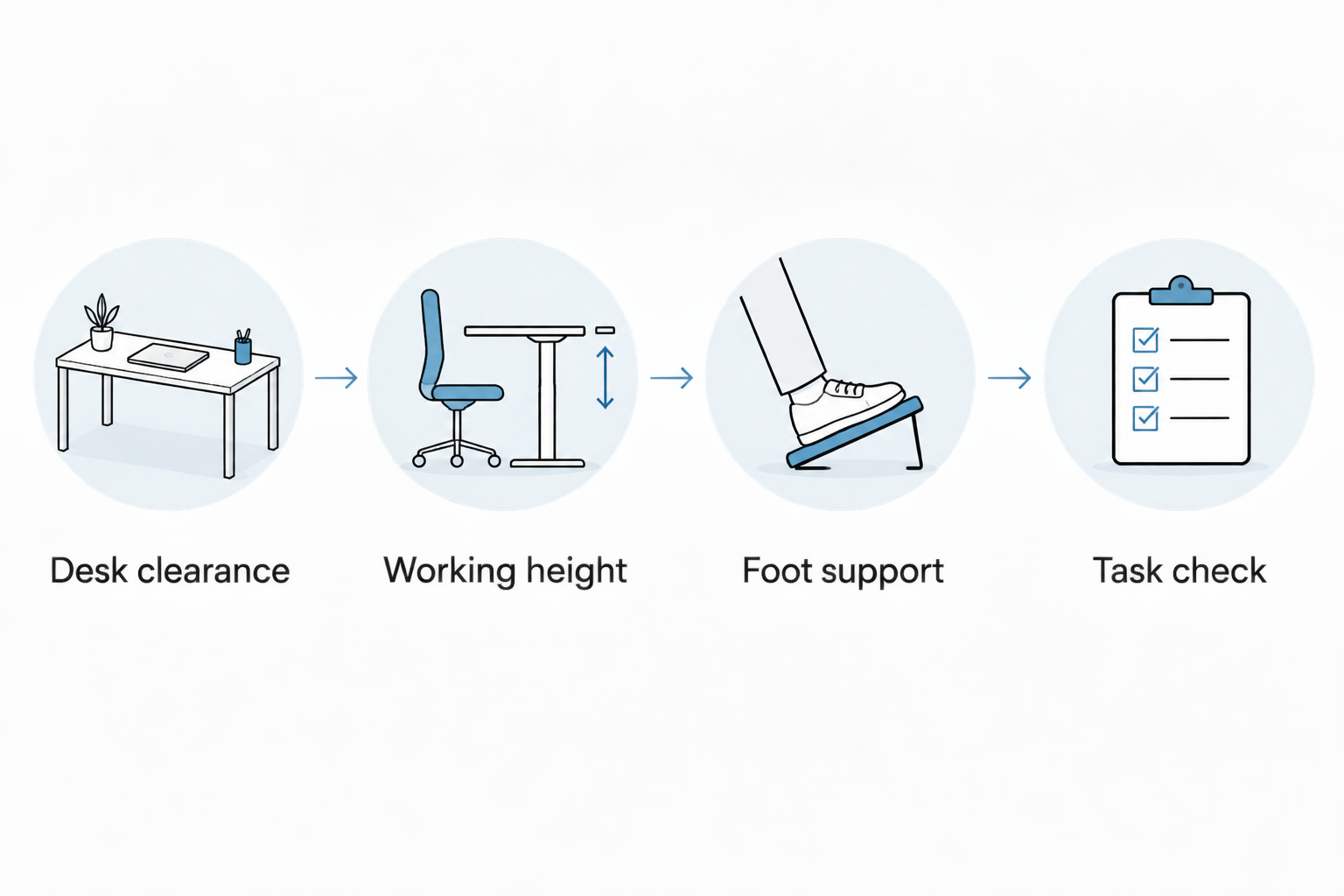
- Desk clearance: Measure the available space beneath the desk, including drawers, rails, and cable trays. Check where your thighs and the stool must fit.
- Working height: Identify the sitting position that lets you reach the keyboard and mouse without raising your shoulders or stretching forward.
- Foot support: Check whether your feet remain supported at that working height. Do not select a taller setup solely to imitate a product photograph.
- Task check: Recreate typing, reading, calls, and getting up from the desk. Include the tasks you do repeatedly, not just your preferred sitting pose.
For a 2026 purchase, request clarification when a specification does not explain how the stool is configured. Overall chair height is not the same measurement as seat height, and a product image does not establish an adjustment range.
Check body fit as well as desk fit
Product dimensions and intended-user guidance answer different questions. The Small Ergonomic Saddle Seat Stool for Petite Women listing describes intended users as approximately 5 feet 2 inches or shorter and 125 lb or less. Those are model-specific selection details, not universal limits for saddle stools.
The Narrower Seat 360° Dynamic Motion Ergonomic Saddle Stool Holland Made description specifies a 13-inch seat. A narrower seat measurement does not establish whether the stool lowers enough for you or whether its base fits beneath your desk.
Treat user guidance, seat dimensions, and height range as separate checks. None substitutes for the others.
Which product features should you compare first?
The following examples illustrate documented differences in seat fit. They are comparison candidates, not a ranked recommendation or a substitute for checking the complete specifications.
| Product | Best for evaluating | Listed feature | Remaining fit question |
|---|---|---|---|
| USA Patented Twin Tiltable Saddle Stool with Adjustable Seat Width and Center Gap | Width and sitting-angle adjustment | Adjustable width and sitting angle | Does the configured height suit your desk and feet? |
| Small Ergonomic Saddle Seat Stool for Petite Women | Petite-user suitability | Intended-user height and weight guidance | Do the actual seat and height dimensions fit you? |
| Narrower Seat 360° Dynamic Motion Ergonomic Saddle Stool Holland Made | Narrower single-seat fit | Listed narrow seat dimension | Does the moving seat suit your preferred working position? |
The first example adds adjustment choices. The second provides specific intended-user guidance. The third identifies a narrower seat, but none establishes that its fit is right for your workstation without further checks.
Sithealthier saddle stools span different seating formats; compare the functions you need rather than treating every saddle as interchangeable. The cards below identify the first two comparison examples.


Should you replace your office chair with a saddle stool?
Keep your office chair until you know the saddle stool fits your normal work. Use the saddle for a defined task and assess whether you can work without sacrificing necessary support or reach.
Do not judge the decision by whether you can tolerate a new position. Judge whether the position works. If you repeatedly brace your feet, lift your shoulders, or move away from the work surface to use the backrest, revisit the setup.
Is a clinical saddle stool better for working from home?
Clinical labeling does not establish better home-office fit. Medical and dental seating includes task-specific formats, including upper-limb supports and surgeon-style seating. Choose those features only when they address your actual work.
For home charting or administrative tasks, start with keyboard reach, display placement, and support. Do not add clinical features merely because you use specialized seating in a treatment room.
Can a saddle stool fix back pain?
A saddle stool is not a treatment for back pain. Seat shape and adjustment are buying considerations, not evidence that a chair cures a condition or guarantees an outcome.
If sitting causes persistent pain, numbness, or other symptoms, seek advice from a qualified healthcare professional. Do not use an ergonomic product label as a diagnosis or treatment plan.
FAQ
Is a saddle stool worth it for a home office?
A saddle stool is worth considering when you want a saddle sitting position and can fit it to your desk. Keep a supported chair if you still need its backrest or arm support for other tasks.
Is a saddle stool better than an ergonomic office chair?
A saddle stool is not universally better than an ergonomic office chair. Compare the seat fit, support, and workstation compatibility required for your work.
Should I choose a saddle stool with a backrest?
Choose a saddle stool with a backrest if you want back contact while using a saddle seat. Confirm that the backrest reaches your working posture and check its documented adjustments.
Will a saddle stool work with my existing desk?
A saddle stool works with your existing desk only when the seat height, foot support, and underside clearance fit together. Measure the workspace and compare the exact stool configuration before ordering.
Are split-seat saddle stools adjustable in width?
Some split-seat saddle stools specify adjustable width, but a split design alone does not establish that function. Check the individual model's listed adjustments.
What size saddle stool should a petite person choose?
A petite person should compare seat dimensions, seat-height range, and intended-user guidance rather than selecting by the word small. Confirm foot support and desk clearance as separate checks.
Can I use a saddle stool for every task at home?
Choose saddle seating task by task rather than assuming it will replace every chair function. Assess typing, reading, calls, and any work that requires back or arm support.
One last thing
A backrest only helps your working position if you can use it while reaching the work. Check that relationship before deciding that a saddle with more support features is the better choice. For your final 2026 decision, prioritize usable fit over the length of the feature list.
Leave a comment