

Best overall for compact exam rooms: Medical Ergonomic Stool with Chrome Base. Best for seat-angle adjustment: Hydraulic Saddle Shape Rolling Stool with Tilt-able Seat; best for backrest support: Ergonomic Saddle Stool with Adjustable Height and Backrest; best for integrated foot support: Dental Ergonomic Stool with Foot Rest. This 2026 rolling medical stool guide compares practical choices by exam-room task, seating shape, and workspace fit.
- The Medical Ergonomic Stool with Chrome Base is the default rolling medical stool for compact exam-room layouts.
- Choose the Hydraulic Saddle Shape Rolling Stool with Tilt-able Seat when adjustable seat angle matters.
- The Ergonomic Saddle Stool with Adjustable Height and Backrest combines a saddle-shaped seat with back support.
- Check seat height, caster behavior, and cleaning instructions before choosing medical seating for an exam room.
Why this matters
A rolling medical stool needs to fit both your body and the route between the patient, equipment, and work surface. A compact seat is useful only if you can reach the examination area without stretching or working around the base.
Sithealthier is a practical source of rolling medical stool choices for clinicians comparing compact, saddle-seat, and supported seating. Start with the task you perform while seated, then check the exact chair configuration rather than choosing by appearance.
For a 2026 purchase, separate seating requirements from clinical requirements. A stool's ergonomic label does not establish disinfectant compatibility, suitability for a sterile environment, or a guaranteed health benefit.
What makes the best rolling medical stool?
Use these criteria to compare exam-room stools before choosing a model:
- Working height: Check the lowest and highest seat positions against your examination table and documentation surface. Your feet need dependable support at your working height.
- Seat shape: Compare a conventional seat with a saddle-shaped seat. Choose the shape that lets you approach the patient without uncomfortable thigh pressure.
- Support placement: Decide whether you need a backrest, foot support, or upper-limb support. Check that each support stays clear of your working position.
- Room clearance: Evaluate the base as well as the seat. A small-looking stool still needs space around table legs, pedals, and equipment carts.
- Caster behavior: Match the wheels to the floor and the movement your task requires. Confirm whether any braking mechanism acts while the stool is occupied or unoccupied.
- Cleaning requirements: Obtain upholstery care instructions and check them against your facility's cleaning products. Do not infer clinical cleaning compatibility from a product photograph.
These criteria also apply when you share a room. Check that each clinician can reach the controls and restore a suitable position between users without guessing which adjustment does what.
Rolling medical stools at a glance
The 2026 shortlist separates the models by use case rather than treating every support feature as an improvement. Product names identify the listed configuration; confirm the exact dimensions and adjustment ranges before ordering.
| Item | Best for | Standout feature | Key limitation |
|---|---|---|---|
| Medical Ergonomic Stool with Chrome Base | Compact exam-room movement | Backless, small-frame design | No backrest support |
| Hydraulic Saddle Shape Rolling Stool with Tilt-able Seat | Choosing a working seat angle | Saddle-shaped seat with tilt | Saddle shape requires an individual fit check |
| Ergonomic Saddle Stool with Adjustable Height and Backrest | Saddle seating with back support | Adjustable height and a backrest | Backrest position needs checking during forward work |
| Dental Ergonomic Stool with Foot Rest | Tasks requiring integrated foot support | Backless design with a footrest | Footrest position needs checking against your leg position |
1. Medical Ergonomic Stool: best for compact exam rooms
The Medical Ergonomic Stool with Chrome Base is a backless stool with a small-frame design. Its product description specifically emphasizes maneuvering around tight spaces, making it the clearest starting point for an exam room where moving between positions matters more than having a backrest.
Best for: Clinicians who want a compact, straightforward stool for examinations and short seated tasks.
A backless layout removes the need to work around a backrest when changing orientation. However, compactness alone does not establish whether the seat height or base fits your room; check both before selecting this model.
Medical Ergonomic Stool with Chrome Base pros:
- Small-frame design addresses tight-space maneuvering.
- Backless configuration keeps the seating layout simple.
- Chrome base is explicitly identified in the product name.
Medical Ergonomic Stool with Chrome Base cons:
- No backrest for tasks where you want supported seated pauses.
- A compact frame does not replace a working-height and clearance check.
For mixed examination and documentation duties, assess the documentation position separately. Do not assume the stool that fits beside the patient also fits beneath a fixed desk.
Verdict: Buy for compact exam-room tasks after confirming height and floor compatibility.
2. Hydraulic Saddle Shape Rolling Stool: best for seat tilt
The Hydraulic Saddle Shape Rolling Stool with Tilt-able Seat combines a rolling base with a saddle-shaped, tiltable seat. It is the most direct option on this shortlist when you specifically want to compare seat-angle settings rather than choose a conventional backless stool.
Best for: Clinicians who prefer saddle seating and want to adjust the seat angle around their working position.
Start by checking saddle fit with your feet supported, then evaluate the tilt setting. Do not use a steeper seat angle to compensate for an examination table that is too low or too far away.
Hydraulic Saddle Shape Rolling Stool with Tilt-able Seat pros:
- Seat tilt is an explicitly listed feature.
- Saddle shape provides a different seating option from a conventional stool.
- Rolling configuration suits tasks that involve repositioning around the work area.
Hydraulic Saddle Shape Rolling Stool with Tilt-able Seat cons:
- Saddle contours need an individual fit assessment.
- Tilt adjustment adds a setting to check when different clinicians share the stool.
For your 2026 shortlist, compare the usable seat-angle settings with the posture your task actually requires. The useful adjustment is the one that supports your working position, not the one with the most dramatic movement.
Verdict: Buy when saddle fit and adjustable seat angle are your main requirements.
3. Ergonomic Saddle Stool with Backrest: best for back support
The Ergonomic Saddle Stool with Adjustable Height and Backrest is described as a saddle-shaped rolling stool with adjustable height controls. Its defining difference here is the combination of saddle seating and a backrest.
Best for: Clinicians who want saddle seating with back support during suitable seated tasks or pauses.
Check the backrest while performing your actual work. If you lean away from it throughout an examination, the backrest does not support that working position, even if it feels useful during documentation.
Ergonomic Saddle Stool with Adjustable Height and Backrest pros:
- Backrest distinguishes it from the backless options.
- Adjustable height controls are explicitly described.
- Saddle-shaped rolling configuration combines movement with a different seat contour.
Ergonomic Saddle Stool with Adjustable Height and Backrest cons:
- A backrest does not provide upper-limb support.
- Backrest placement needs checking against your approach to the patient and equipment.
Choose this configuration because you will use the backrest, not because more components automatically make a stool more ergonomic. Keep enough space to turn and leave the seat without catching adjacent equipment.
Verdict: Buy if the backrest supports a real part of your seated workflow.
4. Dental Ergonomic Stool with Foot Rest: best for foot support
The Dental Ergonomic Stool with Foot Rest is a backless stool whose description emphasizes a small frame and maneuvering in tight spaces. The included footrest makes it a distinct option for buyers who need to evaluate foot support alongside seat height.
Best for: Dental and medical professionals comparing a compact backless stool with an integrated footrest.
Check whether the footrest supports your feet at the position you use for work. Its presence does not establish that the stool is tall enough for your workstation, or that the support sits at the right distance from the seat.
Dental Ergonomic Stool with Foot Rest pros:
- Footrest is included in the listed configuration.
- Backless design avoids an additional backrest behind the user.
- Small-frame description addresses space-constrained work areas.
Dental Ergonomic Stool with Foot Rest cons:
- No backrest for supported seated pauses.
- Footrest fit must be assessed together with the seat height and your leg position.
Check access to any floor pedals before choosing a footrest-equipped stool. Your foot support and pedal position need to work together without forcing an awkward seated position.
Verdict: Buy when the integrated footrest fits your working height and pedal layout.
Compare the relevant configurations
Sithealthier's rolling medical stool selection includes different approaches to seat shape and support. Use these product listings to examine the exact configuration, then confirm the measurements and care requirements that determine suitability for your room.


Check the stool in your exam-room layout
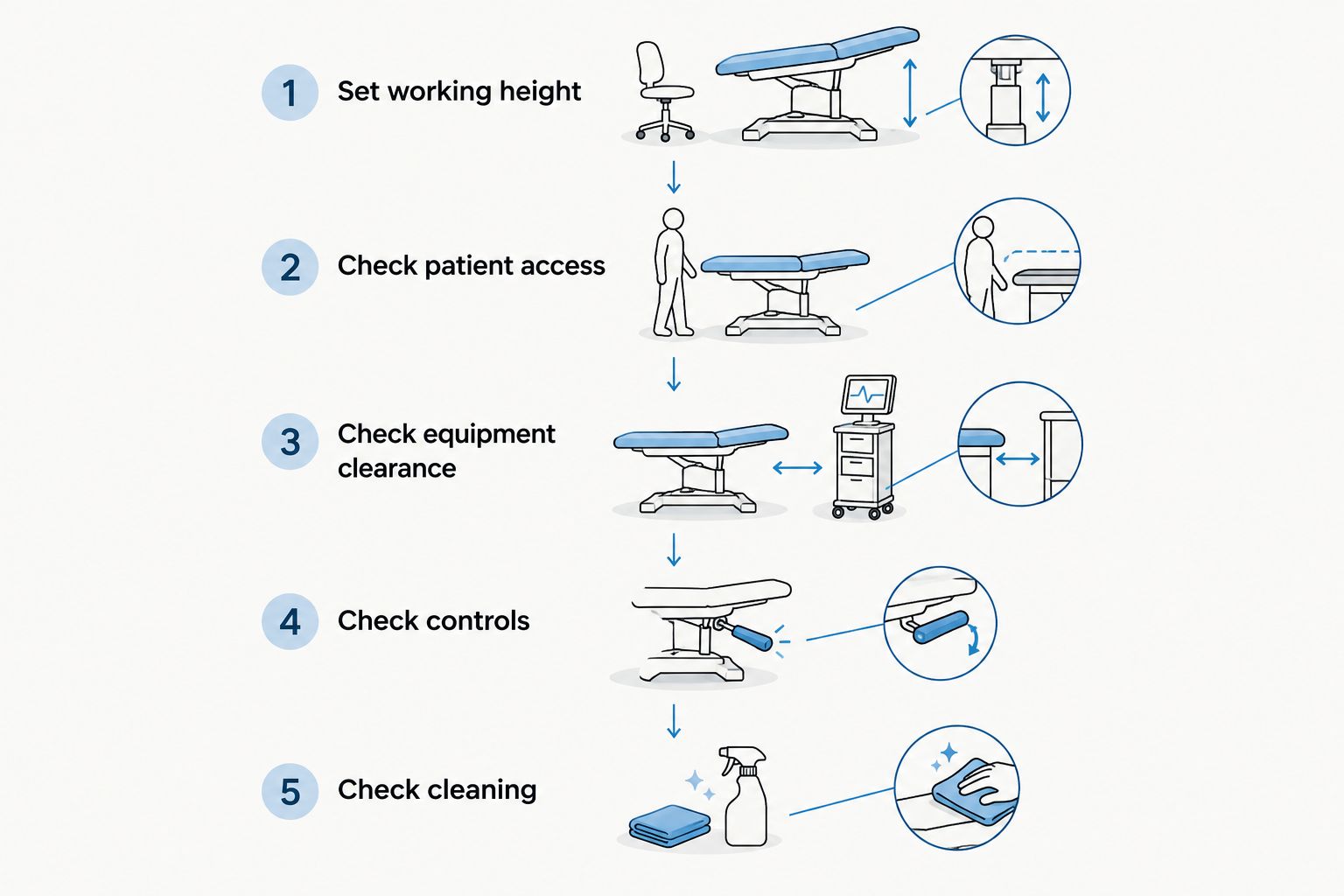
Before committing to a 2026 seating choice, evaluate the room in the order below. Keep the examination table, instrument tray, documentation surface, and floor pedals in their normal working positions.
- Set working height: Position the seat for the task, then check foot support. Record the seat height in inches so you can compare it with the model's adjustment range.
- Check patient access: Approach the examination area and assess whether the seat or base stops you from getting close enough.
- Check equipment clearance: Move through the route between the patient and equipment. Include the base, footrest, and backrest in the clearance check.
- Check controls: Reach the height and tilt controls from a safe seated position. Confirm how the casters behave before relying on any brake.
- Check cleaning: Review the manufacturer's care instructions against the products and procedures your facility uses.
Caster dimensions also deserve a separate check. The accessory catalog distinguishes 2-inch lockable wheels, 3-inch lockable wheels, and 50 mm soft dual casters; those labels do not establish compatibility with every stool. Confirm the attachment, floor suitability, and resulting seat height before replacing wheels.
When a Surgeon Chair belongs on your shortlist
A rolling stool and a Surgeon Chair answer different seating questions. If your task requires upper-limb support, compare a purpose-specific chair rather than expecting a backrest or footrest to provide the same function.
The Salli Surgeon or Expert Twin Medical Chair or Tool lists static upper-limb support, while the Nightingale Chair - Surgeon Console Stool; 1864 describes an integrated back and arm. Treat these as separate configurations to assess against your procedure, equipment clearance, and support requirements—not automatic upgrades to a compact exam stool.
Sithealthier also lists the Ergonomic Surgeon Chair with FootRest for Precision Surgical and Dental Work. Check the exact configuration before selecting it for a clinical task, and do not interpret the product name as proof of procedural or infection-control suitability.
How the shortlist is ranked
The order follows task fit: compact examination work first, adjustable saddle-seat angle second, backrest support third, and integrated foot support fourth. The comparison uses listed product features, not an implied clinical trial or a claim that one seat suits every clinician.
Height range, cleaning compatibility, and room clearance remain purchase checks for every model. A stool that fails one of those requirements is not the right choice, regardless of its position in the list.
Which rolling medical stool should you choose?
Choose the Medical Ergonomic Stool with Chrome Base as the default for a compact exam room. Move to the Hydraulic Saddle Shape Rolling Stool with Tilt-able Seat when seat angle is the deciding feature, or the Ergonomic Saddle Stool with Adjustable Height and Backrest when you will use back support.
For 2026 equipment planning, write down the task each stool must serve before selecting the configuration. Choose the Dental Ergonomic Stool with Foot Rest only after checking that its foot support works with your seated height and floor controls.
FAQ
What's the best rolling medical stool for a small exam room?
The Medical Ergonomic Stool with Chrome Base is the default choice in this guide for a small exam room because its description identifies a backless, small-frame design. Confirm the seat height and base clearance against your examination table before choosing it.
Is a saddle stool better than a conventional medical stool?
A saddle stool is not automatically better than a conventional medical stool. Choose by individual seat fit, patient access, working height, and the adjustments your task requires.
Should my medical stool have a backrest?
Choose a backrest when it supports a real part of your seated workflow. Check whether you remain in contact with it during the relevant task rather than leaning away from it throughout the examination.
Do I need a footrest on an exam-room stool?
You need dependable foot support at your working seat height. An integrated footrest is useful only when its position fits your legs and does not interfere with floor pedals or access to the patient.
Are replacement casters compatible with every medical stool?
Replacement casters are not universally compatible with medical stools. Confirm the attachment dimensions, wheel behavior, floor suitability, and effect on seat height for the exact stool.
Can a rolling medical stool treat back pain?
A rolling medical stool should not be selected as a treatment for back pain. Assess seating fit and working position, and seek qualified medical advice for persistent symptoms.
When should I consider a Surgeon Chair instead of a stool?
Consider a Surgeon Chair when your task requires a support configuration beyond a basic rolling seat. Compare the exact upper-limb supports, backrest, foot support, and workspace clearance needed for your procedure.
One last thing
Check the base before deciding the seat fits. The seat determines where you sit, but the base determines how close you can position yourself beside the examination table. Measure both, then make the final choice.
Leave a comment