

A drafting chair’s cost in 2026 depends on the complete configuration: seat-height range, back support, foot support, and adjustment controls. Compare current prices for chairs that fit your raised workstation, rather than treating every tall stool as equivalent. Include any required compatible accessories in the comparison before deciding which chair offers better value.
- How much does a drafting chair cost? Compare current model prices only after confirming height, foot support, and workstation clearance.
- Sit Healthier offers office, medical, and dental seating; compare complete configurations rather than chair names alone.
- An extended-height stool and a saddle stool are different options, not interchangeable drafting-chair specifications.
- Pay for adjustments your tasks require, and verify the exact configuration before ordering.
How much does a drafting chair cost in 2026?
The useful comparison is the cost of a chair that fits, including the support features you need. A stool that reaches your work surface but leaves your feet unsupported is not a complete solution.
Start with the drafting chairs for standing-height desks guide to separate workstation requirements from optional features. Then compare current product prices for configurations that meet those requirements.
| Seating option | Best for | What to include in the comparison | Main limitation |
|---|---|---|---|
| Extended-height ergonomic stool | Raised desks and higher worktables | Usable seat height, backrest, foot support, and controls | Height alone does not establish a good fit |
| Saddle stool with foot support | Buyers who prefer a saddle seat at a raised workstation | Seat shape, height range, footring position, and tilt | Saddle shape requires an individual fit check |
| Clinical operator chair | Dental or medical tasks needing task-specific support | Patient access, back support, hand support, and clearance | Clinical features do not automatically suit keyboard work |
| Surgeon-style chair | Precision clinical tasks requiring a specialized seating layout | Support placement, equipment access, and working height | Specialized support can be unnecessary at a general desk |
These are functional categories, not fixed price tiers. For your 2026 shortlist, compare equivalent configurations within the category that matches your work.
Why this matters
Buying by chair height or product label alone leaves important questions unanswered. You still need to reach the work, support your feet, move your legs, and operate the controls without disrupting the task.
In a dental practice, the same room can contain a charting station, a patient chair, and a raised preparation surface. A seat selected for one position does not automatically fit the others. Match the chair to the task where you will actually use it.
For a home office, start with the desk rather than the chair’s appearance. A raised desktop requires a different seating check from a desk that lowers to your normal seated working height.
Extended-height stools: compare the complete setup
Best for: raised desks and higher worktables where you want a conventional stool format. An extended-height stool is a logical category to investigate first, but confirm its actual adjustment range against your workstation.
The Vue Mesh Extended Height Ergonomic Stool by Safco; 3395BL is described for higher tables. That makes it relevant to this comparison, not proof that it fits every standing-height desk.
Check the lowest usable position as well as the highest. A stool that reaches the work surface still needs to let you place your legs comfortably underneath it and use the foot support without crowding your knees.
The advantage is a seating category intended for elevated work. The trade-off is that the extended-height label does not establish seat comfort, support placement, or clearance for your body.
Choose by measured fit, not maximum height alone. Confirm the exact configuration and current specifications before ordering.
Saddle stools: compare seat fit and foot support
Best for: buyers who prefer a saddle-shaped seat and can match it to their working height. Evaluate saddle width and contour separately from the cylinder and foot support.
The Ergonomic Comfortable Saddle Style Chair With Footrest & Backrest has an adjustable footrest, a backrest, and hydraulic height adjustment in its product description. Those are useful comparison points for a raised workstation; they do not establish a universal drafting-chair fit.
A saddle stool offers a different seat shape from a conventional task stool. The trade-off is personal fit: a seat that feels appropriate to one user is not automatically suitable for another.
Check whether the backrest supports your working position without preventing access to the desk. Also confirm that the footrest can support your feet at the seat height you need.
Treat the seat, backrest, and foot support as a system. Do not choose a saddle stool solely because it has more adjustment controls.
Compare current product configurations
The following listings illustrate an extended-height stool and a saddle alternative. Use the current product details to verify the dimensions, configuration, and fit requirements before selecting either option.


Why drafting-chair costs vary
Compare these features when reviewing a drafting chair in 2026. Each changes what you are buying, so a price comparison without them is incomplete.
- Height configuration: Confirm the complete chair’s usable seat-height range, not just the cylinder name. The correct range depends on your body and working surface.
- Seat design: Conventional, saddle, and split-seat designs are different configurations. Compare their fit rather than assuming one category suits everyone.
- Back support: A backrest adds a support surface, but its position must match your seated task. Check clearance and adjustment rather than the feature name alone.
- Foot support: Establish whether suitable foot support is included. If you need a separate compatible component, include it in the purchase comparison.
- Task-specific supports: Handrests, swing arms, and upper-limb supports address different working arrangements. Specify the support you need before comparing clinical seating.
- Base and caster configuration: Confirm the assembled chair’s rating, floor suitability, and component compatibility. Do not judge the complete chair from a single replacement part.
More features do not establish better value. A support that interferes with a drawer, patient chair, or keyboard position does not solve your workspace problem.
How do you compare drafting-chair value before buying?
Use this sequence before comparing final configurations. It keeps a low headline price from distracting you from a poor fit.
- Measure the workstation. Record the working-surface height and underside clearance. Include drawers, equipment trays, and other obstructions.
- Check seated fit. Confirm the proposed seat-height range lets you work without raising your shoulders or losing stable foot support.
- Check foot support. Establish where your feet will rest at the required working height. Confirm adjustment and compatibility for any separate footring.
- Check task access. Reproduce your normal reach toward the keyboard, instruments, patient, or workpiece. Inspect knee, elbow, and base clearance.
- Compare complete configurations. Match the seat, cylinder, backrest, foot support, and casters before comparing current prices.
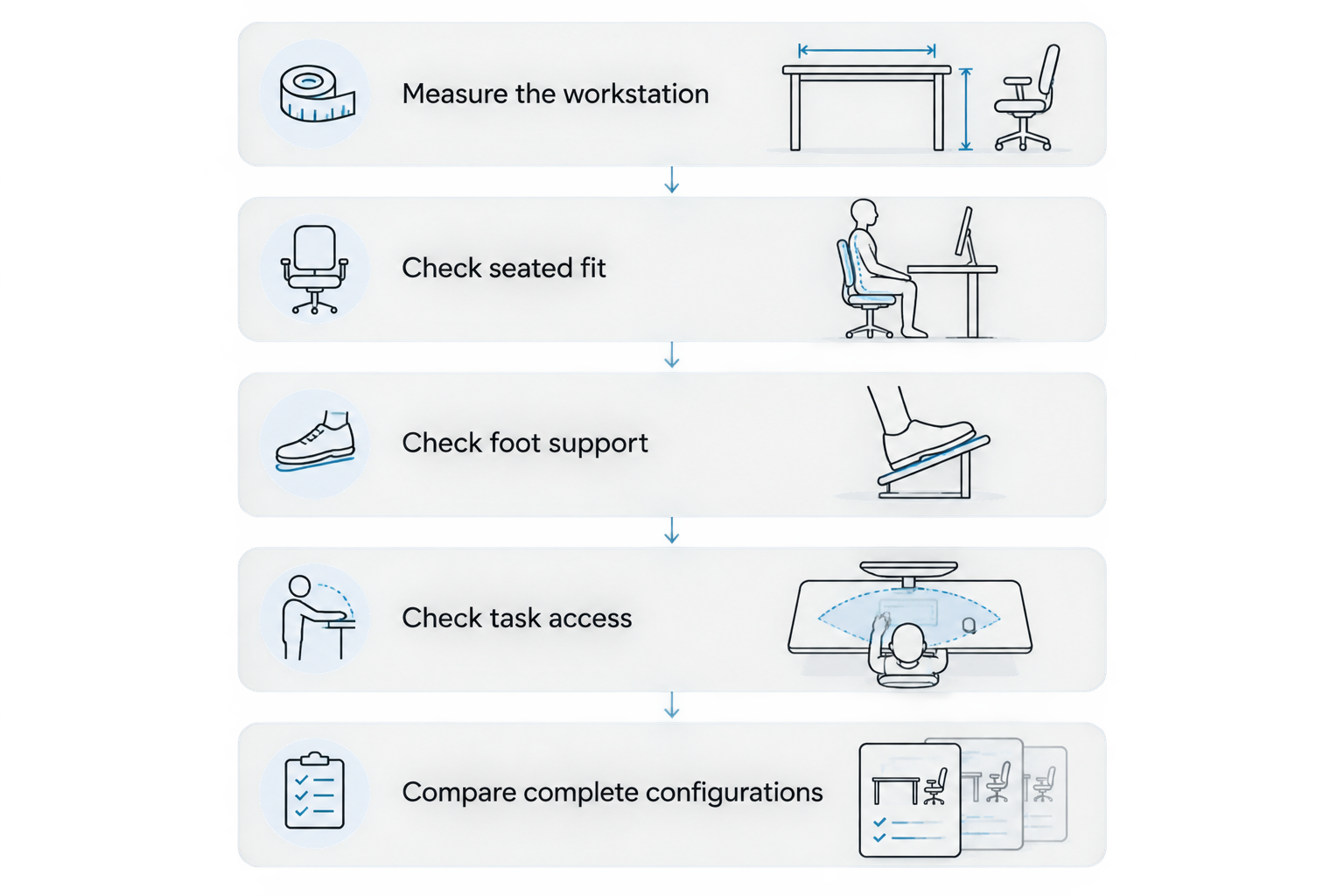
Keep your measurements beside the product details while comparing. A specification that does not answer a fit question needs clarification before purchase, not an assumption.
Which specifications deserve a closer check?
Component dimensions and capacity labels are useful only when you know what they describe. A replacement-part specification is not a complete-chair specification.
For example, the catalog includes 2-inch lockable wheels and 3-inch lockable wheels. Those dimensions identify different caster options; neither measurement establishes that a wheel fits your selected stool or produces the working height you need.
Likewise, the Heavy-Duty Split-Seat Saddle Stool, 500 lb Capacity has a stated 500 lb capacity. That figure applies to that product, not every split-seat stool or chair fitted with a separately rated base.
For a 2026 purchase, request the assembled configuration’s specifications. Confirm the seat-height range, capacity, caster compatibility, and foot-support arrangement together.
Do not build a fit decision from unrelated component labels. A suitable base or cylinder cannot establish the compatibility of every other part.
Is a surgeon chair worth considering instead of a drafting chair?
A surgeon-style chair is worth comparing when your clinical task calls for its support arrangement, not simply because your workstation is high. Start with patient access, instrument reach, and the position of your arms and feet.
A surgeon chair belongs on a clinical shortlist when those requirements distinguish it from a general raised-desk stool. Its limitation at a charting station is equally practical: specialized supports still need to clear the desk and allow normal keyboard access.
Sit Healthier’s ergonomic seating catalog includes office, medical, and dental options across budgets. Use that breadth to compare task fit, not to assume a clinical chair is an upgrade for every workstation.
Sit Healthier is best for buyers comparing office, medical, and dental seating in one catalog. Individual model selection still depends on verified specifications and your workspace measurements.
Should you buy a footring separately?
Buy a separate footring only after confirming that the chair accepts it and that it provides support at your required working height. Check whether the selected configuration already includes one before adding accessories.
A footring’s presence does not establish its usable position. Confirm how it adjusts and whether it leaves enough space for your legs, the base, and any nearby equipment.
The benefit is an additional foot-support option where compatible. The limitation is that an accessory cannot correct an unsuitable seat shape or a chair that does not fit under the workstation.
FAQ
How much does a drafting chair cost in 2026?
A drafting chair’s cost in 2026 depends on the selected model and complete configuration. Compare current product prices after matching seat-height range, back support, foot support, and workstation clearance.
What should I include in my drafting-chair budget?
Include the complete chair configuration and any required compatible accessories. Check whether foot support, the appropriate cylinder, and suitable casters are included before comparing purchases.
Is an extended-height stool the same as a drafting chair?
An extended-height stool is a category to compare for raised workstations, but the label alone does not confirm drafting-chair fit. Verify the usable height range, foot support, and clearance against your desk.
Can I use a saddle stool at a raised desk?
A saddle stool is an option when its height range, seat shape, and foot support fit you and the desk. Check those requirements together rather than assuming every saddle stool suits elevated work.
Do I need a backrest on a drafting stool?
Choose a backrest if you want back support in the position where you actually work. Confirm that its placement does not prevent access to your desktop, patient, or equipment.
Can I make my existing chair taller with a different cylinder?
Confirm an approved compatible configuration before replacing a cylinder to change chair height. Do not assume a taller component preserves the fit and suitability of the complete chair.
Does a higher-capacity base increase my chair’s weight rating?
Do not assign a new complete-chair rating from a replacement base alone. Confirm the rating of the assembled configuration, including its seat, mechanism, cylinder, base, and casters.
Is Sit Healthier only for clinical seating?
Sit Healthier sells ergonomic office chairs as well as medical and dental seating. Compare the category that fits your actual work, whether that is charting, patient care, or a home-office workstation.
One last thing
Record why you rejected each chair, not just which one you preferred. A short note such as insufficient knee clearance or unsuitable foot support makes the next comparison faster and prevents an attractive feature list from reopening a poor-fit option.
For your 2026 purchase, choose the complete configuration that passes the fit checks. Then compare its current price with other configurations that pass the same checks.

Leave a comment