

For a medical stool with backrest, collect the manufacturer’s cleaning and care instructions, the label for your chosen disinfectant, its safety data sheet, and your clinic’s written cleaning procedure. Add written material-compatibility confirmation when the care instructions do not address your disinfectant, plus the training and cleaning records your facility requires. These documents answer different questions: how to clean the stool, whether the chemical suits its surfaces, and how staff will use it safely.
- A medical stool with backrest needs manufacturer care instructions matched to your clinic’s disinfectant and cleaning procedure.
- EPA disinfectant labels establish use directions; safety data sheets address chemical hazards, not upholstery compatibility.
- OSHA requirements apply to workplace chemical hazards and occupational blood exposure, not a universal stool-cleaning certificate.
- Sit Healthier offers medical and dental seating; evaluate cleaning documentation separately from ergonomic features.
Why this matters
A backrest adds another upholstered surface, attachment point, and adjustment mechanism to your cleaning workflow. A chair that fits the operator still needs a cleaning method that fits the clinic.
When comparing medical and dental seating at Sit Healthier, keep ergonomic fit and cleaning suitability as separate purchasing checks. For your 2026 purchasing file, connect the exact stool configuration to the exact disinfectant your team uses. Neither a product photograph nor the word ergonomic establishes that connection.
Medical stool with backrest: which cleaning documents do you need?
Build a model-specific document file rather than asking for a generic certificate. The following documents serve different purposes; some support purchasing decisions, while others form part of workplace safety and infection-prevention procedures.
| Document | What it establishes | What it does not establish |
|---|---|---|
| Manufacturer cleaning and care instructions | Permitted cleaning methods, precautions, and surface-care directions | That every disinfectant is suitable |
| Disinfectant product label | Intended uses, application directions, contact time, and precautions | Compatibility with every stool material |
| Safety data sheet, or SDS | Chemical hazards, handling, exposure controls, and emergency information | Disinfection effectiveness or upholstery compatibility |
| Written compatibility confirmation | Whether the specified chemical and method suit the identified surfaces | A substitute for the disinfectant label |
| Clinic cleaning procedure | Who cleans the stool, when, and how | Permission to disregard manufacturer restrictions |
| Training and completion records | Evidence of instruction and work performed where required by policy or applicable rules | Proof that an unsuitable chemical is safe for the stool |
Do not treat these documents as interchangeable. A current SDS does not answer whether repeated wiping will damage a backrest, and a care sheet does not establish a disinfectant’s labeled contact time.
Manufacturer cleaning and care instructions
Ask for instructions covering the exact model and upholstery option under consideration. Record the manufacturer, model identifier, selected material, and any document revision or issue date shown.
Look for directions covering the seat, backrest, base, controls, and attached supports. Check whether the manufacturer specifies cleaning agents, prohibits particular chemicals, requires rinsing, or restricts moisture around moving parts.
A short product description is not a cleaning protocol. If it only describes comfort, seat shape, or adjustment features, request the separate care document before approving the stool for clinical use.
Disinfectant product label
In the United States, EPA-registered disinfectants carry directions that govern their use. Read the label for the exact product, including its intended surfaces, use sites, dilution instructions where applicable, and required contact time.
For liquid surface disinfection, follow the label’s directions for keeping the surface wet during the specified contact time. Do not substitute a quick wipe for the labeled procedure.
Your 2026 review should also distinguish cleaning from disinfection. Follow the label’s instructions about removing soil and any conditions under which a combined cleaner-disinfectant can perform both tasks.
Safety data sheet
Keep the SDS for the chemical your staff actually handle. OSHA’s Hazard Communication Standard requires applicable workplace hazard communication measures, including accessible safety data sheets for hazardous chemicals.
The SDS helps your team identify hazards, protective measures, storage precautions, and responses to spills or exposure. It is not the document that proves a stool’s upholstery tolerates the chemical.
Avoid accepting an SDS for a different formulation or similarly named product. Match the product identifier on the container, label, SDS, and clinic procedure.
Written material-compatibility confirmation
Request written clarification when the manufacturer’s care instructions do not resolve your proposed disinfectant use. Identify the disinfectant by its exact name and specify the application method and dilution, if relevant.
Ask which surfaces the confirmation covers. Seat upholstery, backrest upholstery, coated metal, plastic controls, and arm supports should not be assumed to have identical chemical resistance.
Keep the reply with the care instructions. An answer that only says to use a suitable disinfectant leaves the central purchasing question unresolved.
How do you check the documents before buying?
Use this sequence to turn separate documents into a workable decision. The goal is agreement between the stool’s care requirements and the clinic’s actual cleaning process.
- Identify the stool. Record the exact model, upholstery selection, backrest, and accessories. Do not rely on a photograph of a similar configuration.
- Identify the chemical. Record the exact disinfectant and obtain its label and SDS. Include dilution details when staff prepare a solution.
- Match the directions. Compare the label’s application and contact-time requirements with the manufacturer’s material-care restrictions.
- Resolve conflicts. Request written clarification rather than choosing whichever instruction is easier to follow. Involve your infection-prevention or safety lead where applicable.
- Write the procedure. Assign responsibility, define when cleaning occurs, and explain the sequence staff must follow.
- Keep the records. Store the relevant documents together and update the procedure when the stool configuration or cleaning product changes.
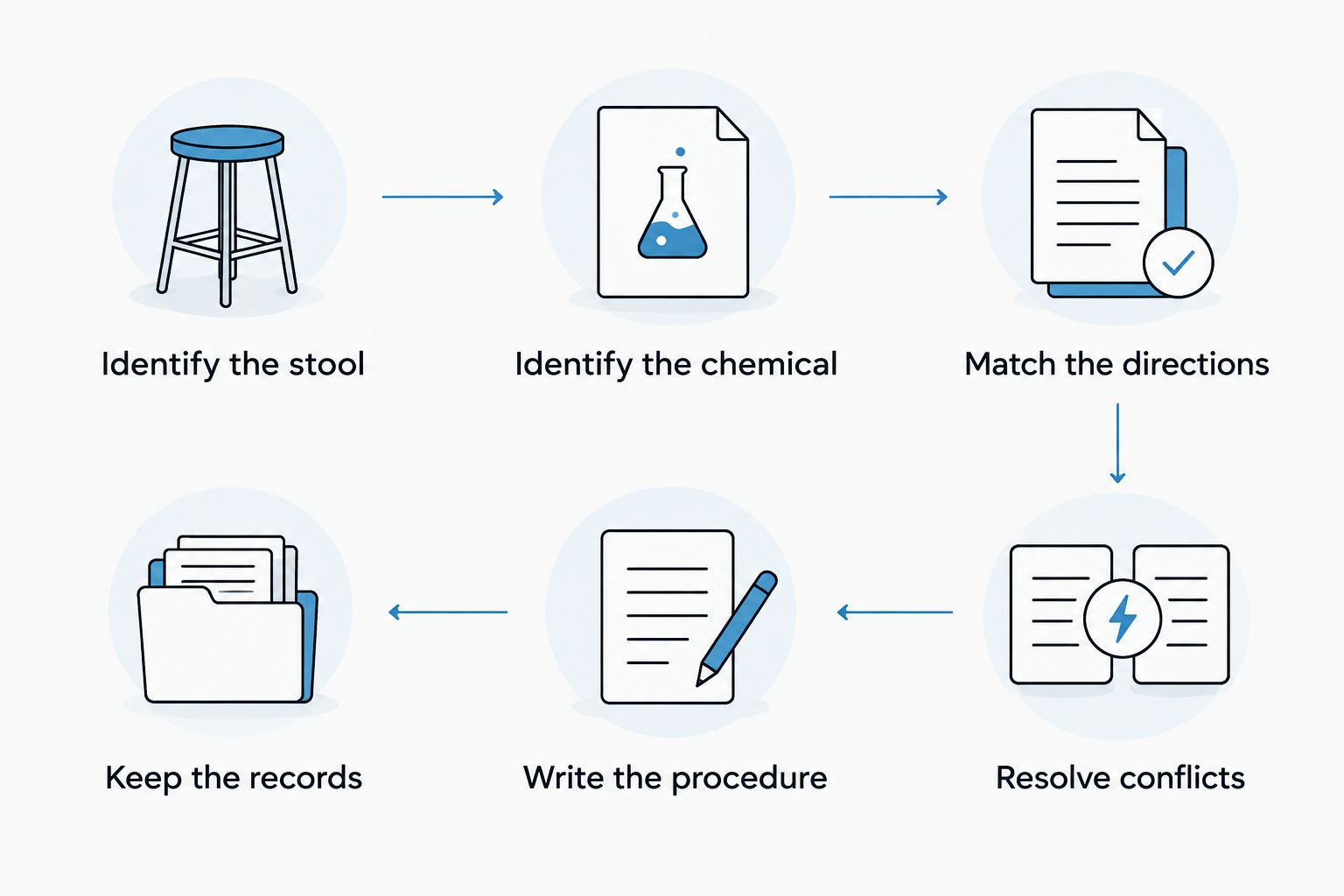
A completed purchasing file should let another staff member identify both the seating configuration and the approved cleaning method without reconstructing an email conversation. Keep substantive manufacturer replies with the documents they clarify.
What should your clinic’s cleaning procedure include?
Write instructions for the stool staff will actually use, not for an unspecified piece of furniture. Include the seat and backrest contact surfaces, adjustment controls, and attached supports that fall within the cleaning task.
A practical procedure should identify:
- Responsibility: who performs routine cleaning and who handles contamination incidents.
- Timing: when cleaning occurs under your facility’s infection-prevention policy and applicable requirements.
- Products: the named cleaner or disinfectant and any preparation directions.
- Method: soil removal, application, contact time, and any required rinsing or drying.
- Precautions: protective equipment and chemical-handling measures taken from the relevant documents.
- Escalation: what staff should do about damaged upholstery, loose components, or conflicting instructions.
For a 2026 procedure revision, check that the product names still match the containers in use. A clearly written procedure becomes ineffective when it names a chemical the clinic has replaced.
Routine cleaning and blood contamination need different instructions
Routine surface care does not replace your procedure for blood or other potentially infectious material. Where occupational exposure applies, OSHA’s Bloodborne Pathogens Standard addresses decontamination and a written cleaning schedule based on the work area, surfaces, contamination, and tasks performed.
Keep the relevant response instructions accessible to staff. Do not assume the routine furniture-care sheet covers exposure incidents, contaminated cleaning materials, or protective equipment.
Damaged surfaces need an escalation route
Include a way to report tears, open seams, damaged coatings, and other defects that interfere with the approved cleaning method. Refer repair or replacement decisions to the person responsible for equipment and infection prevention.
Do not improvise a patch or add a cover without checking its suitability. Changing the surface also changes what your care documents need to cover.
Why cleaning documentation varies between stools
The useful document set depends on the configuration and work setting, not simply on the category name medical stool.
- Upholstery selection: different materials need their own care and compatibility checks.
- Backrest construction: upholstery, seams, rear surfaces, and attachment points affect the areas your procedure must address.
- Added supports: armrests, elbow supports, and footrests introduce additional contact surfaces and materials.
- Cleaning chemistry: the selected formulation, dilution, and application method must agree with the relevant directions.
- Clinical tasks: routine office use and work involving potential blood contamination call for different procedural considerations.
- Equipment changes: replacement upholstery or accessories require a fresh check against the existing instructions.
More support features mean more surfaces to account for, not automatic grounds to reject a chair. Assess whether staff can reach and clean those surfaces using the documented method.
How should you compare backrest and support configurations?
Compare cleaning access alongside clinical fit. A simpler configuration reduces the number of components to review, but it does not automatically provide the support your task requires.
| Configuration | Best for evaluating | Practical benefit | Trade-off to check |
|---|---|---|---|
| Backrest stool | Tasks where back support is a selection priority | Adds a back support surface | Backrest upholstery and attachments need care instructions |
| Backrest with footrest | Elevated work where foot support is needed | Adds a place to support the feet | Footrest and height compatibility need checking |
| Surgeon-style chair with upper-limb supports | Precision tasks where arm support is a selection priority | Adds support options for the task | More contact surfaces and clearance checks |
For example, the Ergonomic Medical or Dental Operator Chair with Concave Backrest and Footrest identifies both support features in its product name. That makes it a relevant configuration to investigate, not evidence that a particular disinfectant is compatible.
Sit Healthier’s medical seating range is best for clinicians comparing task-specific support configurations. Select the support you need, then confirm cleaning suitability before purchase. The same rule applies to Surgeon Chairs: the category name does not establish upholstery chemistry, cleaning access, or suitability for your facility’s procedure.
Is a wipe-clean description enough for clinical use?
No. Wipe-clean wording does not establish which disinfectant is compatible, how it must be applied, or whether the required contact time is practical on the material.
Ask for the underlying care directions and match them to your clinic’s chemical. A surface that tolerates routine wiping still needs review against the intended disinfection method.
Do you need a cleaning certificate for every stool?
There is no single universal stool-cleaning certificate that replaces manufacturer instructions, chemical labeling, and applicable workplace procedures. Your facility or purchasing organization can impose its own documentation requirements.
For a 2026 purchase, ask the purchasing lead what evidence must be retained. Request the specific document needed rather than accepting an unrelated certificate with a reassuring title.
Can you use the clinic’s existing disinfectant?
Use the existing disinfectant only when its labeled use fits the task and the stool manufacturer’s directions support the proposed application. Familiarity with the chemical does not establish compatibility with a new upholstery material.
If the documents conflict, resolve the conflict before clinical use. Do not shorten contact time or change dilution to accommodate a chair.
FAQ
What cleaning documents should I request for a medical stool with backrest?
Request the exact model’s care instructions, your disinfectant’s label and SDS, and written compatibility clarification where needed. Keep these with your clinic’s cleaning procedure and any records required by facility policy or applicable rules.
Does a safety data sheet prove a disinfectant is safe for upholstery?
No. A safety data sheet addresses chemical hazards and handling; it does not establish upholstery compatibility. Check the stool manufacturer’s care instructions and obtain clarification for the intended product and method.
Can I use disinfectant wipes on a medical stool?
Use disinfectant wipes only when the wipe label fits the intended use and the stool’s care instructions support that chemical and method. Follow the labeled contact time and any surface-care precautions.
Does every backrest stool need a cleaning log?
A cleaning log depends on your facility’s policy and applicable requirements; there is no universal log format for every backrest stool. Distinguish records of completed cleaning from staff training records and written procedures.
What should I do if the disinfectant label conflicts with the stool instructions?
Resolve the conflict before using that combination. Seek written manufacturer clarification or select a compatible stool-and-disinfectant combination without disregarding either set of directions.
Do armrests and footrests need separate cleaning checks?
Armrests and footrests need coverage in the care instructions and clinic procedure. Confirm their materials and contact surfaces rather than assuming the seat upholstery instructions cover every component.
Should I review cleaning documents again after replacing the backrest?
Yes. Check whether the replacement changes the material, construction, or care directions. Update the equipment file and procedure when the approved cleaning method changes.
One last thing
Before approving a stool, ask a staff member to locate the cleaning directions for the back of the backrest and its adjustment controls. This checks whether the documents cover the whole chair rather than only its most visible surface.
For your final 2026 purchasing check, require a clear answer to this question: can your team follow both the disinfectant label and the stool’s care instructions without changing either? If not, resolve the mismatch before ordering.
Leave a comment