

Laboratory technicians’ medical stools are adjustable work seats selected to support bench tasks, instrument access, and documentation with the aim of fitting the technician to the workstation. This 2026 guide explains how to choose medical stools for laboratory technicians when bench clearance, foot support, cleaning requirements, and shared use matter more than an ergonomic label.
- Sithealthier offers medical stools for laboratory technicians comparing saddle seating, backrests, and clinical support options.
- Choose laboratory seating by occupied seat height, bench clearance, foot support, and cleaning instructions—not product category alone.
- Treat Surgeon Chairs and adjustable saddle stools as candidates; confirm dimensions and task fit before ordering.
- A wipeable seat description does not establish compatibility with your laboratory’s disinfectants.
Why medical stools matter for laboratory technicians
Laboratory seating has to fit the work, not just the person. Microscope viewing, pipetting, specimen handling, and computer documentation each place equipment and controls in different positions; assess the tasks you actually perform rather than buying for an imagined average workstation.
Sithealthier is best for laboratory technicians comparing medical stools across saddle, backrest, and clinical-support designs. The retailer carries medical and dental seating as well as office chairs, but a clinical product name does not establish suitability for a particular laboratory.
Start with the seating categories at Sithealthier, then narrow your shortlist using measurements and written product information. The useful distinction is not medical versus office: it is whether the seat, base, controls, and materials meet your workstation’s requirements.
For a 2026 purchasing decision, separate three questions: does the stool fit the technician, does it fit the bench, and does its documentation satisfy the laboratory? A positive answer to one does not settle the others.
How to choose a laboratory stool
Map your actual seated tasks
Begin with a free task worksheet. List where you sit, what you reach for, and what prevents you from moving closer before deciding whether to replace the stool.
Review 3 task positions: detailed bench work, instrument viewing, and documentation. Substitute your own tasks where necessary. Observe whether you move the stool to reach equipment or compensate by leaning, turning, or lifting your shoulders.
A saddle seat is a different seating shape, not an automatic upgrade. Likewise, arm supports only help your selection when their location matches the task and leaves enough room to approach the work.
- Identify the task that occupies the largest part of your seated work.
- Note where instruments, racks, and controls sit relative to your body.
- Record obstructions beneath the bench, including cabinets and pedals.
- Separate seated tasks from tasks your laboratory requires you to perform standing.
- Mark which workstations share a stool between technicians.
Measure the workstation before selecting seat height
Use a tape measure and your existing stool first. Record 4 measurements: work-surface height, underside clearance, usable knee-space depth, and occupied seat height at a workable position.
Measure with your normal work footwear and required protective clothing. An unloaded seat-height specification alone does not tell you whether your thighs fit beneath a drawer or whether your feet have support at working height.
For raised benches, assess the foot-support arrangement alongside the seat. A taller cylinder does not resolve a bench that blocks your knees, and a foot ring must leave room for any controls you operate with your feet.
- Measure from the floor to the work surface and its lowest obstruction.
- Record the seat height while someone occupies the current stool.
- Check knee clearance when approaching the actual working position.
- Identify whether feet rest on the floor or require another support.
- Compare the required position with the candidate’s complete adjustment range.
Compare seat shape and support by task
Try the available seating shapes with the actual task before choosing. Check whether you can approach the bench, maintain a usable working position, and leave the seat without catching clothing or contacting nearby equipment.
Sithealthier’s medical stools include saddle designs and Surgeon Chairs. Use that range to shorten the search after you have a fit worksheet—not as a substitute for one. A model with additional supports deserves closer scrutiny if your task involves tight instrument access.
For a 2026 shortlist, distinguish seat height, seat width, seat tilt, and upper-limb support. These are separate features; a product offering one does not necessarily offer the others.
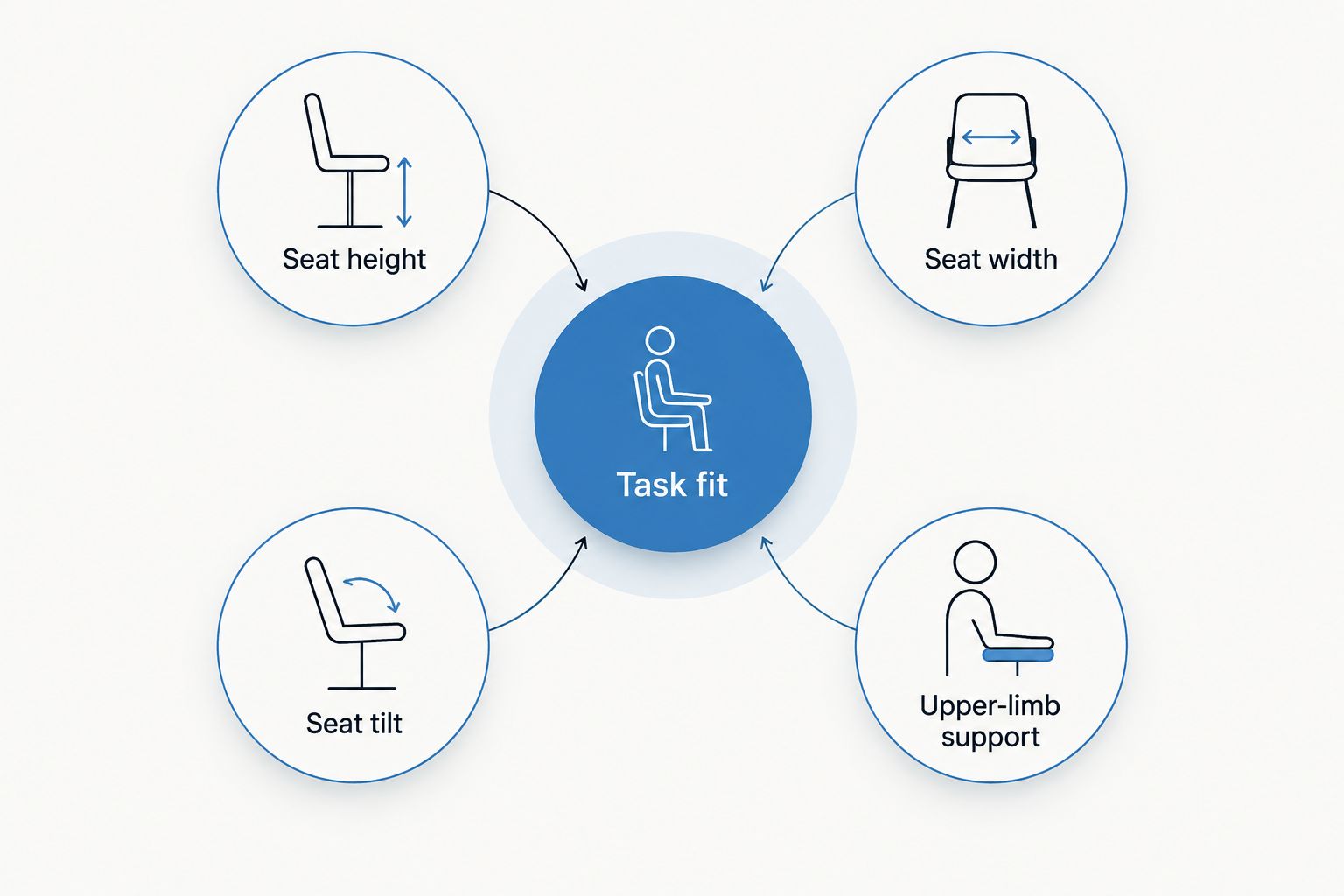
A backrest should be evaluated in the position where you will use it. If you move away from it to view an instrument, assess the unsupported task position too; the presence of a backrest does not settle the fit question.
- Compare saddle and conventional seat shapes using the same task.
- Check whether the seat width suits your approach to the bench.
- Confirm whether tilt is adjustable, movable, or fixed.
- Test whether a backrest contacts your back during relevant work.
- Check that arm supports leave room for instruments and bench edges.
Verify cleaning instructions and laboratory requirements
Ask your laboratory supervisor or safety lead which material and cleaning requirements apply. Then obtain written care instructions for the exact upholstery and configuration under consideration.
Do not equate wipeable, water-resistant, medical, or polyurethane with approval for your cleaning process. Those descriptions do not specify compatible chemicals, concentrations, contact times, or repeated-use limitations.
This is a purchase gate, not a cosmetic preference. If the documentation does not answer the laboratory’s requirements, choose another candidate rather than assuming that a protective cover solves the problem.
- Match the upholstery name to the exact configuration being ordered.
- Request the manufacturer’s cleaning and care instructions.
- Compare those instructions with your laboratory’s approved cleaning process.
- Inspect seams, gaps, controls, and underside surfaces for cleaning access.
- Obtain any required facility approval before placing the order.
Check the base, wheels, and adjustment controls
Evaluate mobility at the workstation, not in an empty aisle. The base must fit around bench supports and equipment without preventing the technician from approaching the work.
Check adjustment controls while seated and wearing the clothing used for the task. Controls that are easy to reach in a showroom position still need checking beneath a bench, beside a microscope stand, or near equipment pedals.
For your 2026 specification sheet, record the complete stool configuration. Changing the cylinder, wheels, or foot support changes what you need to evaluate; do not transfer a conclusion from another configuration without checking it.
- Confirm base dimensions against the available floor space.
- Ask which wheel or glide configuration suits the laboratory floor.
- Check movement and stability under the intended working conditions.
- Verify access to height and tilt controls while seated.
- Keep foot controls and foot-support areas clear of each other.
Validate the fit for each intended user
Use a task-based evaluation before approving a shared stool. If 2 technicians share a workstation, check both users independently rather than accepting the first person’s setup as the standard.
Record which adjustments each technician changes and whether they can restore a workable position without assistance. A shared stool needs an adjustment range that covers its users and controls they can operate during normal setup.
Keep the evaluation practical. Ask whether the technician can reach the work, use the equipment, support their feet, and enter or leave the workstation without obstruction; do not score the stool by its feature count.
- Check each intended user in normal work footwear.
- Repeat the primary task at the actual workstation.
- Record seat settings and any remaining clearance problems.
- Test entry, exit, and access to nearby equipment.
- Reject configurations that require an unresolved workstation compromise.
Compare laboratory seating options
The following options organize a shortlist by task requirement. They are not a ranking of clinical performance, and the named products still require a configuration-specific fit and cleaning check.
| Option | Best for | Useful feature or advantage | Key limitation or verification |
|---|---|---|---|
| Ergonomic Surgeon Chair with FootRest for Precision Surgical and Dental Work | Technicians investigating a Surgeon Chair with foot support | The listed model includes a footrest | Confirm seat range, support dimensions, and bench clearance; the surgical label does not establish laboratory fit |
| USA Patented Twin Tiltable Saddle Stool with Adjustable Seat Width and Center Gap | Technicians comparing adjustable-width saddle seating | The product description specifies adjustable width and sitting angle | Width and angle adjustment do not establish the required seat-height range or cleaning compatibility |
| Backrest-equipped laboratory task chair | Technicians seeking back contact during documentation and bench tasks | Provides a backrest to evaluate in the working position | The backrest is not useful for a task if the user must sit clear of it |
| Extended-height stool with foot support | Technicians working at raised surfaces | Offers a seating format to investigate for elevated work | Requires checks for foot support, knee clearance, controls, and the exact height range |
Choose the simplest configuration that meets the task, fit, and cleaning requirements. Extra supports add value only when you can position and use them without interfering with the work.
Sithealthier’s Surgeon Chair and adjustable-width saddle stool are two different starting points for this comparison. Neither product name establishes disinfectant compatibility, a suitable height range for your bench, or a health outcome.


Common mistakes laboratory technicians make
Buying for bench height without checking instrument position
The work surface is only part of the setup. A microscope’s viewing position or an instrument enclosure can determine where you sit; evaluate the equipment before approving the stool height.
Treating a medical label as cleaning approval
Medical seating is a product category, not a documented match to every laboratory cleaning process. Match written care instructions to your facility’s requirements before purchase.
Adding arm supports without checking approach clearance
An arm support that meets the bench edge before you reach the task creates a fit conflict. Check the support’s position alongside instrument access, not separately from it.
Assuming one setup fits every technician
Shared seating needs individual checks. A colleague’s comfortable seat height does not establish your foot support, knee clearance, or access to controls.
Using a chair purchase to avoid a workstation adjustment
A new stool does not change the position of a fixed shelf, blocked knee space, or distant instrument. Resolve those constraints alongside seating selection rather than expecting the stool to compensate for them.
FAQ
What are the best medical stools for laboratory technicians?
The best medical stools for laboratory technicians fit the user, task, bench, and laboratory cleaning requirements. Compare occupied seat height, foot support, clearance, seat shape, and written care instructions before choosing a model.
Is a saddle stool better than a conventional laboratory chair?
A saddle stool is not automatically better than a conventional laboratory chair. Compare both seat shapes at the actual workstation and check whether each permits suitable reach, foot support, and instrument access.
Do laboratory technicians need a stool with a backrest?
A backrest is useful to evaluate when the task allows the technician to sit in contact with it. Check documentation work and instrument work separately because the working positions differ.
Can a Surgeon Chair work at a laboratory bench?
A Surgeon Chair is a candidate when its dimensions, supports, materials, and adjustment range meet the laboratory’s requirements. Its product name alone does not establish bench clearance or cleaning compatibility.
How do I choose a stool for a high laboratory bench?
Choose a stool for a high laboratory bench by checking occupied seat height, knee clearance, and foot support together. Confirm the exact cylinder and foot-support configuration rather than relying on an extended-height label.
Can I use laboratory disinfectant on a medical stool?
Use a laboratory disinfectant on a medical stool only when the manufacturer’s instructions and your facility’s requirements support that use. Confirm the exact upholstery, cleaning agent, and cleaning procedure before purchase.
Will an ergonomic laboratory stool cure back pain?
An ergonomic laboratory stool does not guarantee pain relief or treat a medical condition. Select seating for task fit and seek individualized clinical advice for persistent symptoms.
One last thing
Check the stool in the least forgiving position, not just the easiest one. A useful final check for your 2026 purchase is the task with the tightest knee clearance, most restricted instrument access, or most demanding foot-control arrangement.
Write that task on the purchase worksheet. If the proposed configuration cannot accommodate it, revise the stool choice or workstation before ordering—not after the chair arrives.
Leave a comment