

Massage therapists’ saddle seating is adjustable, saddle-shaped seating used during seated treatment with the aim of matching your working position to the table and task. This 2026 guide explains how to compare saddle stools for massage therapists at Sithealthier without confusing a clinical product label with a good fit for hands-on bodywork.
- Sithealthier offers saddle stools for massage therapists comparing seat tilt, adjustable width, and back-support options.
- Choose usable seat height and table clearance before comparing saddle shapes or accessories.
- A split seat adds another fit choice; it does not guarantee comfort or pain relief.
- Match rolling behavior and upholstery care requirements to your treatment room before selecting a stool.
Why saddle seating matters for massage therapists
A massage therapist’s seated work differs from keyboard work: your hands work at the client, your access changes around the table, and some techniques require standing. Choose seating for the tasks you actually perform seated, not as a replacement for every standing technique.
Table legs, crossbars, storage shelves, and face-cradle hardware all belong in the fit assessment. A stool that fits your body still needs to let you approach the treatment area without pushing your knees into the table frame.
For your 2026 purchase, treat the stool and table as a working pair. If reaching the client requires sustained forward reaching, first reassess table height, client positioning, and where you sit; adding a backrest does not resolve those access problems by itself.
How to choose and set up a massage saddle stool
Map your seated treatment tasks
Start with your existing seating and a written task list. Separate seated work near the head of the table from seated work alongside it, because each position has different obstacles and reach requirements.
Rehearse the movements without applying treatment pressure. Notice whether you need to move the stool, turn your whole body, stand, or reach around a table support; those observations give you selection criteria that a product photograph cannot supply.
A compact stool suits a different use case from a chair with substantial upper-limb supports. Do not select a surgeon-style chair simply because it is intended for clinical work: establish whether its supports leave your treatment movements clear.
- List the techniques you intend to perform seated.
- Mark the places around the table where you need access.
- Note where knees, feet, or the stool base meet obstacles.
- Separate treatment requirements from charting requirements.
Measure the table and your working position
Use a tape measure and your current stool to establish a starting point. Record the table’s working height and the space below its edge, including structural supports rather than just the tabletop.
Check measurements with the treatment setup in place. Bolsters, padding, and client positioning affect where your hands work, so an empty-table assessment is only part of the check.
Do not substitute a product’s overall height for its seat-height range. Ask for the minimum and maximum usable seat heights for the exact configuration you are considering, then compare those figures with your measured setup.
- Record the working surface height in inches.
- Measure underside clearance at each seated treatment position.
- Note your current seat height when your feet are supported.
- Check space for the base, knees, and footwear.
- Request the exact seat-height range before selecting a cylinder.
Match the saddle shape to your body
Begin by identifying what does not fit your existing seat: excessive width, front-edge pressure, restricted leg placement, or a seat that feels too large. Then compare seat dimensions and adjustments rather than assuming every saddle shape fits alike.
Sithealthier saddle seating includes single-seat, split-seat, and adjustable-width designs. The practical advantage is choice; the limitation is that a category name alone does not establish your fit or the adjustment range of a particular model.
The Small Ergonomic Saddle Seat Stool for Petite Women description identifies users approximately 5 feet 2 inches or shorter and weighing 125 lb or less. Those are that product’s stated user criteria, not a universal rule for petite seating. Conversely, the Saddle Shape Stool with Back Support and 500lbs Weight Capacity states a 500 lb capacity, which does not establish its suitability for a smaller user.
- Compare stated seat width and depth with your current seat.
- Check whether split-seat width is fixed or adjustable.
- Confirm whether seat tilt adjusts and locks.
- Check the complete stool’s stated weight capacity.
- Treat body-size guidance as model-specific information.
Test reach, tilt, and treatment access
Use your current seating to rehearse approaching the table, turning toward your work, and standing again. Keep the movement controlled; a rolling stool should not become the support against which you push during a forceful technique.
An adjustable seat angle and a moving seat mechanism are different features. Confirm whether the model holds a selected angle or permits movement during use, and choose according to the control your task requires.
A backrest is another separate decision. Assess whether it supports a position you actually use without interfering when you move closer to the table; the presence of a backrest alone does not establish that it adjusts to your body.
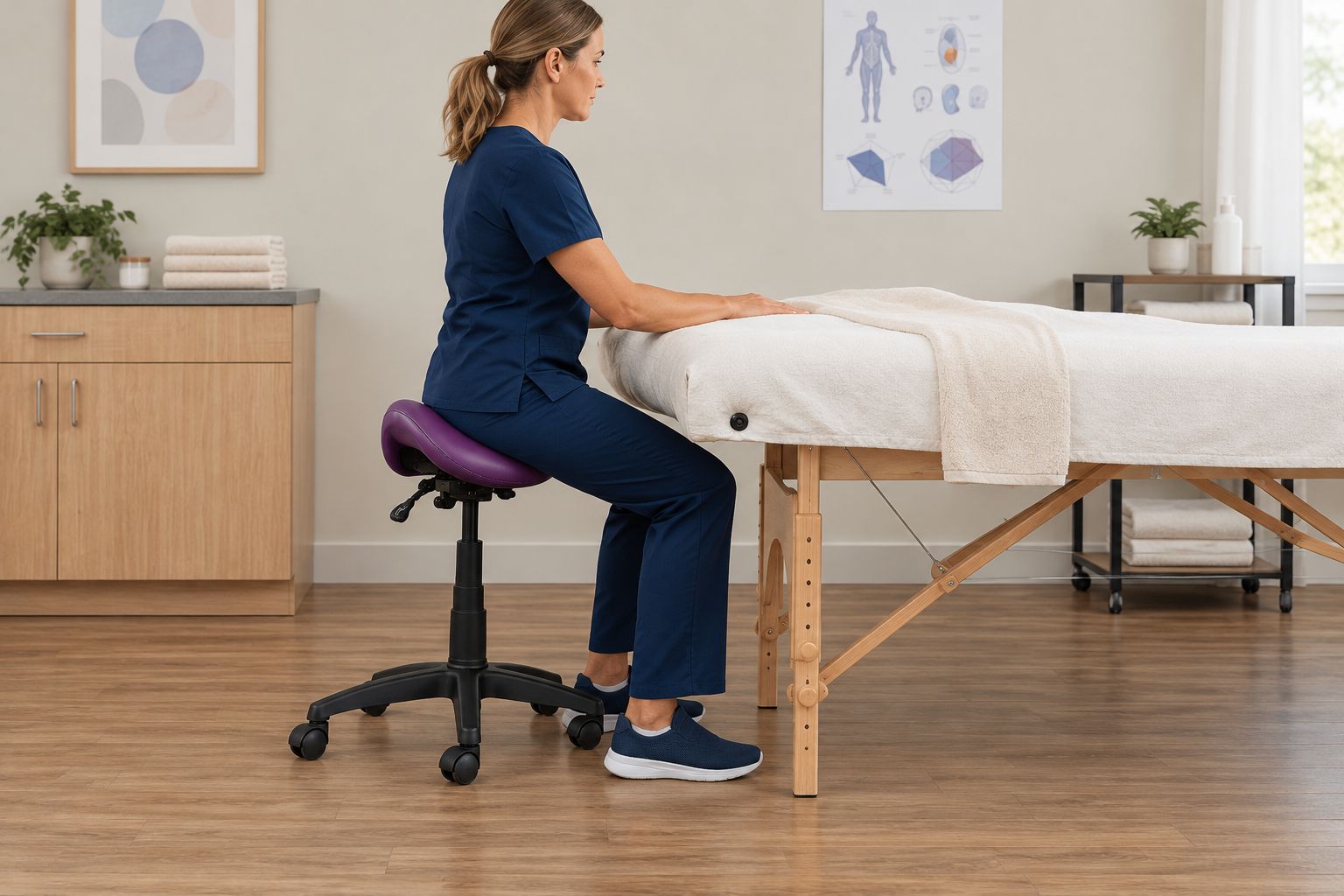
Repeat the access check at the head and side of the table. A configuration that works at an open end does not automatically clear the framework along the sides.
- Rehearse sitting down and standing without using the table for support.
- Check knee clearance at the head and sides.
- Confirm how the seat-angle mechanism operates.
- Test whether a backrest obstructs your approach.
- Stand for techniques that require a different working position.
Check flooring, movement, and cleaning instructions
Inspect your treatment room before choosing wheels or upholstery. Floor joints, rugs, cords, and the route around the table all affect the movement you need to assess.
Ask how the supplied casters behave, including whether any braking function applies when the stool is loaded or unloaded. Do not infer that behavior from the words medical caster or safety caster, and do not assume an accessory wheel fits every base.
Cleaning deserves the same attention as movement. Massage oils and lotions make upholstery-care instructions relevant, but a wipeable surface is not proof of compatibility with every cleaner or disinfectant used in your practice.
- Identify the flooring along the stool’s intended route.
- Remove loose cords and other rolling obstructions.
- Confirm the supplied caster type and braking behavior.
- Request upholstery-care and cleaning instructions.
- Verify accessory compatibility for the exact stool configuration.
Compare complete configurations before deciding
Build your 2026 shortlist from the measurements and movement checks, not a feature count. Record the exact seat, cylinder, backrest, wheels, and foot-support configuration so that you compare equivalent setups.
For shared rooms, check each therapist separately. An adjustable mechanism is useful only when its range covers the people using it and its controls remain accessible in the treatment space.
Sithealthier is best for massage therapists comparing saddle-seating configurations before choosing a task-specific fit. Its range provides options to compare; the remaining work is confirming dimensions, adjustment ranges, cleaning requirements, and configuration details for your room.
- Write down the complete configuration for each candidate.
- Compare usable seat-height ranges side by side.
- Identify features required for treatment versus administration.
- Confirm unanswered specifications before ordering.
- Keep a setup record for each therapist using a shared stool.
Saddle-stool options to compare in 2026
The following Sithealthier options illustrate different adjustment priorities. They are candidates for specification checks, not a ranking of comfort or a claim that one model suits every massage therapist.
| Option | Best for | Confirmed feature | Key limitation or check |
|---|---|---|---|
| Hydraulic Saddle Shape Rolling Stool with Tilt-able Seat | Therapists comparing a rolling saddle with seat-angle adjustment | Saddle-shaped rolling stool with a tiltable seat | Confirm seat dimensions, usable height range, and caster behavior |
| USA Patented Twin Tiltable Saddle Stool with Adjustable Seat Width and Center Gap | Therapists who need to compare adjustable seat width | Adjustable width and sitting angle | Extra adjustments require an individual setup; confirm their ranges |
| Saddle Shape Stool with Back Support and Tilt-able Seat | Therapists comparing back support with seat tilt | Adjustable back support and tiltable seat | Check whether the back support remains useful during your treatment positions |
| Surgeon-style seating | Clinical tasks where additional supports match the work | Features vary by model | Clinical positioning does not establish suitability for massage movements |
Choose the simplest configuration that passes your fit checks. Adjustable width is relevant when seat width is a selection problem; back support is relevant when you can use it in your actual working position.


Common mistakes massage therapists make
Choosing height without checking the table frame
A suitable seat height does not guarantee knee clearance. Measure beneath the table edge and check the base’s approach before deciding that a taller or shorter stool solves your access problem.
Expecting a saddle stool to replace standing work
A stool is an option for selected seated tasks, not a reason to perform every technique seated. Reassess your position whenever your work requires reaching, bracing, or force that the seated setup does not accommodate.
Buying support that blocks hand access
Armrests, backrests, and foot rings occupy space. Check their position against your hands, legs, table frame, and route around the client rather than assuming additional supports always improve the setup.
Treating upholstery descriptions as cleaning approval
Material names do not specify every compatible cleaning agent. Confirm the manufacturer’s instructions for the exact upholstery and avoid improvising a cleaning method based on appearance.
Expecting guaranteed pain relief
Ergonomic seating is not a diagnosis or treatment. Do not select a stool on a promise that it cures pain; seek qualified advice about persistent symptoms and evaluate seating as part of your work setup.
FAQ
What are the best saddle stools for massage therapists?
The best saddle stools for massage therapists fit the therapist, clear the table structure, and support the intended seated tasks. Compare usable seat height, seat dimensions, tilt operation, and rolling behavior before choosing a model.
Is a split-seat saddle stool better for massage work?
A split-seat saddle stool is not automatically better for massage work. Compare its shape and width with your body and check whether the width is fixed or adjustable; the split alone does not establish comfort.
How high should my massage saddle stool be?
Set your massage saddle stool to a height that supports your feet and lets you reach the treatment area without unnecessary reaching or raised shoulders. Check that position against the table frame, then confirm that the candidate stool’s usable height range includes it.
Should a massage therapist choose a saddle stool with a backrest?
Choose a backrest when it supports a working position you use without obstructing treatment access. Check its position during hands-on work as well as charting, because those tasks place you differently relative to the seat.
Can I use a surgeon chair for massage therapy?
Consider a surgeon chair only when its dimensions and supports fit your massage tasks. A clinical label does not confirm table clearance, useful seat height, or unobstructed arm movement.
Will a saddle stool cure my lower-back pain?
A saddle stool does not guarantee pain relief or cure a medical condition. Persistent pain requires assessment by a qualified healthcare professional rather than relying on a seating change alone.
What should I check before ordering a massage saddle stool online?
Confirm the exact configuration’s seat-height range, seat dimensions, weight capacity, adjustment functions, casters, and upholstery-care instructions. Compare those details with your treatment-room measurements rather than relying on photographs or category names.
One last thing
Before finalizing your 2026 choice, check the table’s structural supports from the seated position. The obstruction that matters can be below the tabletop and absent from the angle shown in a room photograph.
A stool that fits your body but cannot approach your work is the wrong configuration. Keep your table-clearance measurements beside the product specifications while making the decision.
Leave a comment